

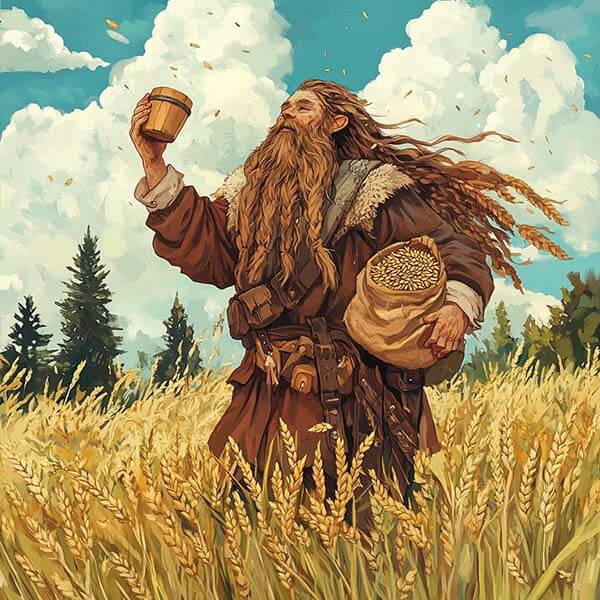
Pekko
God of Crops and Brewing
Karelian / Finnish Mythology
Pekko is the God of Crops, Brewing, and Agriculture in Finnish mythology. His origins stem from Estonia, particularly in Setomaa, a region in the southeastern part of the country. The Seto people, an indigenous Finnic-Ugric group, inhabit this region and continue their worship of Pekko to this day.
Pekko is also known as Peko, Pekka, Pellonpekko, and Pikka, depending on the region. The Seto people revere Pekko as a vice-king and national hero. His origins began as a deity of agriculture. However, they evolved into his representation of barley and beer brewing.
Mentions of Pekko in the Kalevala
The first reference to Pekko in the Kalevala is during the wedding of Ilmarinen and the Maiden of Pojhola. In this story, Osmotar, the creator of beer, must create a sacred drink to bless the wedding. While Osmotar discovers the secret of fermentation, Pekko provides her with barley for brewing the hallowed beer.
Barley is a foundational crop in Finland, Karelia, and Estonia. In the creation story of The Kalevala, the world is not complete until the creation of barley.
Brewing beer is integral to the Finnish identity and is referenced several times throughout the Kalevala. It brings communities together and symbolizes abundance. Like Akka, Pekko is critical to crops. However, the crops in his domain are primarily for agriculture.
Pekko’s Agricultural Domain
Grain is a crucial staple throughout Finland, Estonia, and the regions of Russia in between. It was critical to ensure food security, livestock feed, and exports. Yet, barley is the most significant grain produced in the region due to its versatility.
Agriculture, fertility, and brewing are key aspects of the Kalevala. While Pekko is little mentioned in the poems and songs, his symbolism is inherent.
- Domain: Agriculture, barley, brewing
- Realm: The Earth
- Symbol: Barley
- Weapon/Relic: None
- Spouse: None
- Worship: Brewing ceremonies and agricultural rituals
- Offerings: Barley, Sahti, beer, harvest, bread
- Holidays: Kekri, Juhannus, Spring planting
Pekko’s Ties to the Creation of Sahti
Sahti is one of the oldest brewing styles still in use today. Its origins lie in ancient Finnish farmhouse brewing methods, using traditional ingredients such as barley, rye, and oats. In pagan Finland, sahti brewers often gave tributes to Pekko to gain bountiful barley harvests. These tributes came in the form of wooden idols of Pekko left near the grain storage.
Some evidence suggests that sahti has been around since the 9th century. The discovery of casks on sunken Viking ships led historians to believe that Vikings practiced brewing sahti during that period. In 1366, the earliest written evidence of sahti appeared in a bishop’s burial text, which described the amount of beer he drank.
Celebrating Pekko
Pekko’s celebrations continued after the adoption of Christianity. Before Pentecost, during Candlemas and Midsummer, Finns paid tribute to him. Lighting black candles and placing wooden effigies of Pekko near grain stocks celebrated the harvest Pekko provided.
Kekri (The Harvest Festival)
Finns pay tribute to Pekko during the sowing and harvest seasons. Most notably, during Kekri, or the harvest festival, Finns worship Pekko to gain a bountiful harvest. Wooden effigies with holes for candles in the head were left near granaries to honor Pekko.
Marking the end of the harvest season, Finns partake in feasts, libations, and saunas. The Kekri Festival initially fell on September 29th, but was later moved to coincide with All Saints Day on November 1st. With this change, the Finns began honoring the spirits of their ancestors alongside the other revelries.
Vappu – Spring Planting Festival
The Spring Planting Festival was once a popular event in Finland. However, today this is celebrated as Vappu, or May Day. Despite being near the end of spring, the planting season in Finland traditionally begins in May.
During this time, farmers often scatter barley seeds to honor Pekko. Beer from last year’s harvest and the first sowing are usually gifts provided as tribute. Today, Vappu celebrations resemble those of a carnival. Food vendors, balloons, fans, and masks fill the market squares of major cities. At the same time, many students gather for champagne picnics.
However, a modern convention, Spring Garden (Kevätmessut), takes place in Helsinki and serves as a horticultural trade fair. This event marks the importance of planting and gardening during this time of the year.
Juhannus – Midsummer Festival
Juhannus is an integral part of the holiday season in Finland and other Nordic countries. This festival corresponds with the summer solstice and is often called the Midsummer Festival. Weddings are frequently held around Juhannus because it symbolizes fertility, renewal, joy, and community.
Beer and sahti are integral parts of the Juhannus festival. While many do not specifically honor him, beer brewing holds strong symbolism in the Midsummer Festival. The Nordic countries revel during the Midsummer Festival, partaking in libations as they enjoy endless daylight.