
Akka
Goddess of the Earth
Karelian / Finnish Mythology
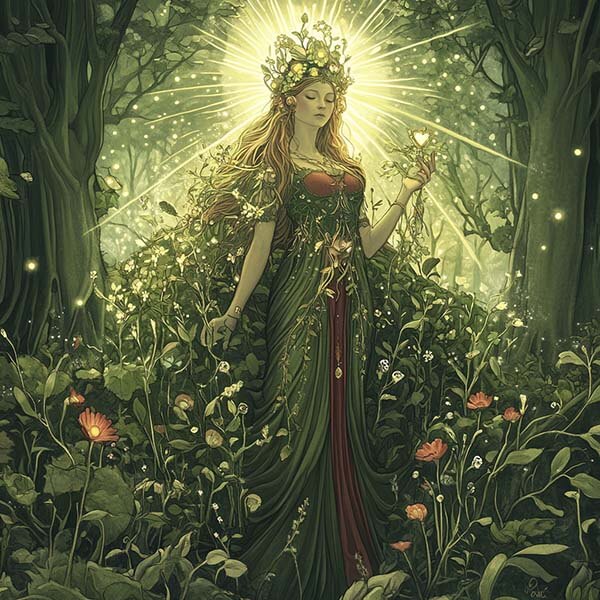
Akka is the Goddess of the Earth, and the wife of Ukko, the God of the Sky. In traditional Finnish runic songs, she is known as Maaemä, meaning “earth mother.” In addition to presiding over the Earth, she is also responsible for soil, fertility, livestock, and nature. Despite being a prominent figure in Finnish mythology, her origins likely stemmed from Estonian mythology first.
What Does Akka Mean?
Akka, in pagan Finland, was an honorific term for an “elderly woman” or “goddess.” Today, its meaning is similar but can vary depending on its context. In traditional Finnish, Akka means “woman” or “wife,” but in some contexts it can be pejorative, meaning “hag.”
Why Did Maaemä’s Name Change to Akka?
The Goddess Akka is worshipped from Estonia to Lapland. In Sámi mythology, she is Maderakka, a Goddess with three daughters: Sarakka, Uksakka, and Juksakka. In Estonian mythology, her name is Maaema, which matches her original Finnish name Maaemä. So why was her name updated to Akka throughout Finnish mythology?
Akka is a term of respect and reverence for the deity. The name infers knowledge, ancestral wisdom, and veneration. Furthermore, the name better matches her spouse, Ukko.
Are Rauni and Akka the Same Person?
Rauni is another name that is often associated with Akka. Initially, this was described by Mikael Agricola, a Finnish Lutheran clergyman, in 1551 during his publications about pagan gods. His publication “Gods of Tavastia (Häme)” represented the deities worshipped by pre-Christian Finns in the region.
In this work, Rauni is a fertility deity. The name could stem from the Swedish word for the rowan tree (rönn), which is closely associated with this Goddess. She may also have gone by the names Ryönikkä or Röönikkä, which translate as “little Freyr,” a popular Nordic deity in southern Sweden at the time. Some speculation also infers that she may once have been a rival to the thunder god Ukko. However, there is little evidence to support this claim.
Omission from the Kalevala
While Ukko plays a prominent role throughout the Kalevala, many of the other pagan deities do not appear. Akka is no exception. While Akka isn’t mentioned much in the Kalevala, her role is inextricably tied to that of Ukko and to maintaining a balance between Earth and the heavens.
Interestingly enough, the rune songs which Elias Lönnrot compiled to create the Kalevala focused on stories from pre-Christian and pagan Finland. Despite this, his work omits many former pagan deities worshipped by the Finns.
Akka’s Domain in Finnish Mythology
Together, Akka and Ukko represent the duality of masculine and feminine energy. The Earth cannot flourish without the help of the heavens. As Ukko controls the weather, these systems are required to bring sustenance for the fertility of the Earth. In turn, Akka is seen as the great mother to life on Earth, sustaining both humanity and nature, thus creating a natural order that Finns revere.
- Domain: The Earth, fertility, motherhood
- Realm: The Earth
- Symbol: A circle or spiral
- Weapon/Relic: None
- Spouse: Ukko
- Worship: Sacrifice, prayer, rituals
- Offerings: Grain, bread, milk, honey, flowers
- Holidays: Matopäivä (Spring Equinox), Juhannus (Midsummer Festival)
Crop Symbolism in Finnish Mythology
As an agrarian culture, crops are integral to sustaining life for the ancient Finns. Grains were among the most essential crops for the ancient Finns. Before planting and sowing began, Finns often prayed to Akka for a bountiful harvest.
Barley is a sacred crop in the Kalevala and one of the most integral. As a staple, barley is tied to the people’s sense of abundance and symbolizes fertility.
Fruits represent the sweetness of life for the Finns. Berries and apples are particularly important, symbolizing the Earth’s generosity. Blueberries, cloudberries, bilberries, currants, and lingonberries are among the most essential fruits for the Finnish people.
Potatoes and other root vegetables are also a key symbol of Akka. These foods represent sustenance and nourishment for the Finns. Carrots, beets, turnips, and potatoes represent strength and stability to the Finns.
Animal Significance in Finnish Paganism
Cows symbolize fertility and abundance in Finnish paganism. These creatures are of great significance to humanity’s success. Livestock were symbols of prosperity, sustenance, and household status. Many pagan Finns also believed that different guardian spirits would look after their cattle throughout the seasons.
In Finnish mythology, birds also symbolize motherhood and carry messages to the gods. These creatures symbolize freedom, as they can roam the lands and skies freely. In the creation story at the beginning of the Kalevala, the Earth’s birth comes from a bird’s egg laid on Ilmatar’s knee. As such, the association of birds with the cosmos recurs throughout Finnish mythology.
Honey, the Nectar of the Gods
Honey also plays a vital role in symbolism and worship in the Kalevala and Finnish Mythology. It symbolizes life’s sweetness, bestows magical properties, and embodies nurturing power. Moreover, honey fosters väki, or life force, to pagan Finns.
Honey is often used in healing potions or salves and is known for its protective and purifying properties. Lemminkäinen’s mother collects a drop of honey in a thimble to revive him after the Swan of Tuonela slays him.
Celebrating Akka
Worshipping Akka generally coincides with agricultural and prosperity rituals. Matopäivä, the day of snakes, is a pagan holiday that corresponds with the Spring Equinox. On this day, celebrations for Akka would occur to wake her from the winter slumber. Matopäivä occurs near the Christian Easter celebrations. While most Finns are Christian today, this holiday doesn’t receive widespread celebrations in modern Finland.
Juhannus, or the Midsummer Festival, is a holiday where Finns embrace some of the beliefs of old. During this celebration, some Finns honor the old gods, such as Akka and Ukko. Unlike Matopäivä, Juhannus is a widely celebrated holiday in modern Finnish traditions. While the Summer Solstice is traditionally associated with Ukko, many also venerate Akka during this festival.
Offerings to Akka generally consist of grains, vegetables, fruits, pies, and sometimes baskets woven from plants. Some offerings also include leaving symbols or animal carvings on an altar for her.
Presence of Female Deities in Finnish Mythology
Finland has always been at the forefront of gender equality, which may be traced back to ancient traditions. Finnish mythology has a variety of female deities, ranking highly in terms of concentration compared with other mythologies around the world.
While some belief systems, particularly Hinduism, Shintoism, West African, and Indigenous belief systems, contain more female deities, Finland compares notably high in terms of concentration. One issue to note is that many of the goddesses in ancient Finnish folklore wield tremendous power over their respective domains.
While Akka commands domain over the Earth, Mielikki governs the forests, Vellamo rules the seas with her husband Ahti, and Tuonetar holds dominion in the Underworld.
Sources
- Joy, Francis. (2011). The History of Lapland and the Case of the Sami Noaidi Drum Figures Reversed. Folklore: Electronic Journal of Folklore, 47, 113–144. https://www.folklore.ee/folklore/sites/default/files/2025-07/fl_ejf_47x.pdf
- Joy, Francis. (2017). Noaidi drums from Sápmi, rock paintings in Finland and Sámi cultural heritage – an investigation. Polar Record, 53(2), 200–219. https://www.cambridge.org/core/journals/polar-record/article/abs/noaidi-drums-from-sapmi-rock-paintings-in-finland-and-sami-cultural-heritage-an-investigation/A7C1B51057AE35BDC199A3A5A5BE36D2
- Ernits, Enn. (1998). Meandash, müütiline saami põder (1. osa). Mäetagused, 6, 118–142. https://www.folklore.ee/tagused/nr6/meanda3.htm
- Ernits, Enn. (1999). Folktales of Meandash, the Mythic Sami Reindeer. Folklore: Electronic Journal of Folklore, 11, 41–60. https://www.folklore.ee/folklore/vol11/pdf/meandash.pdf