

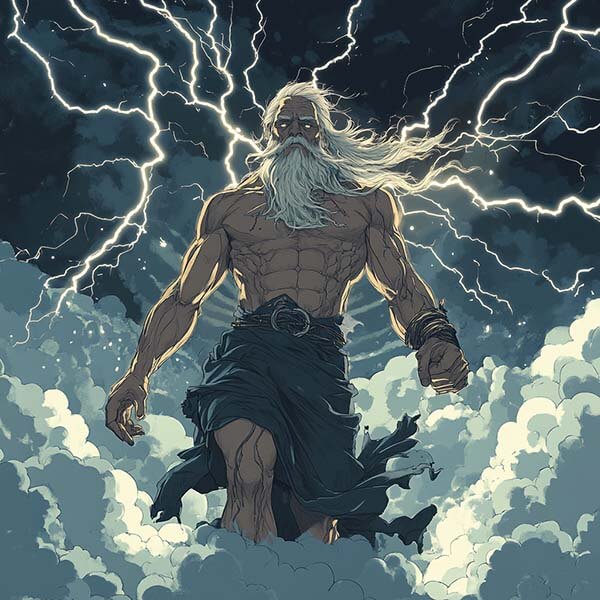
Ukko
God of the Sky
Karelian / Finnish Mythology
While many mythologies from around the world have a god of thunder, Ukko is a unique deity in Finnish folklore. As the principal god, he governs over the sky, thunderstorms, weather, and harvests. His domain is not limited to just thunder and lightning; rather, his dominion extends as the caretaker for life on Earth.
Ukko, the God of the Sky, is married to Akka, the Goddess of the Earth. Together, their union represents the codependence of Heaven and Earth. Weather is integral to fertilizing Earth’s crops. Therefore, Ukko’s domain over the sky realm, Taivas, symbolizes his integral role in providing for life. In addition, the duality of Ukko and Akka represents the bond between masculine and feminine energy in the universe.
What Does Ukko Mean?
Ukko literally translates to “old man” or “grandfather.” However, “ukkonen” means “thunder” or “thunderstorm” in Finnish, which may contribute to the name of this deity. While his origins are unknown, the essence of Ukko may have come from Horagalles, the Sámi god of the sky. Nevertheless, the reference to this god as an “old man” with a long grey beard represents his wisdom and celestial station.
The Influence of Thunder and Lightning
Sitting upon a cloud in the Vault of the Sky in Taivas, the Heavens, Ukko presides over the heavens and the rainbow roads that run through them. Despite being an old man, he remains a mighty warrior, wielding Ukonvasara, his magical hammer. Some versions of the myths portray this as an axe called Ukonkirves. This weapon produces lightning as Ukko wields it. He also frequently wields a bow, symbolizing rainbows, which shoots fiery arrows that create lightning as they strike the Earth.
Ukko’s chariot emits thunder and lightning as it rides across he rainbow roadways in Taivas. Furthermore, intimacy between Ukko and Akka results in thunder rolling across the heavens.
- Domain: The sky, thunder, weather, and harvest
- Realm: Taivas
- Symbol: Rowan Tree
- Weapon/Relic: Ukonvasara, “Ukko’s Hammer”
- Spouse: Akka
- Worship: Bonfire burning, feasts
- Offerings: Beer, bread, and honey
- Holidays: Juhannus (Midsummer Festival) and Vakkajuhlat or Vakkas
Ukko’s Role in The Kalevala
While the heroes play the central roles in The Kalevala, they ask Ukko for favors to overcome their trials. Throughout their adventures, the heroes call upon him in times of need. Generally, they beseech “the old man” as they request aid on their adventures.
Forging of the Sampo
The Sampo is the most important relic in the Kalevala. It has the power to create unlimited quantities of grain, salt, and gold, making it a source of immense wealth for whoever possesses it. Väinämöinen initially agrees to create this relic for Louhi in exchange for one of her daughters’ hands in marriage.
When Väinämöinen must create the sacred Sampo for Louhi, he enlists the help of Ilmarinen, the Eternal Blacksmith. Despite his skill, they must call upon Ukko, who sends a divine fire to power the forge to complete the sacred artifact.
Lemminkäinen’s Favors
After Lemminkäinen’s death at the hands of the Swan of Tuonela, his mother begins a quest to find out what happened to her son. Upon finding his dismembered body in the River of Tuonela, she commences sewing her son back together, but this fails to bring him back to life.
The first and perhaps most significant favor Ukko grants Lemminkäinen is by providing his mother with sacred honey, which brings him back to life. As she prays to Ukko, Lemminkäinen’s mother sends a bee to collect the healing salve from the halls of the Sky God. The bee eventually returns with a thimble full of the sacred honey.
Later, Lemminkäinen also calls upon Ukko in his travels throughout Pohjola. In one instance, he must overcome a fiery chasm when traveling to attend the feast. He prays to the old man to quench the fire, who sends a storm to answer the prayer.
Väinämöinen’s Favors
When Väinämöinen sets out to Pohjola, Joukahainen ambushes him, causing the hero to become lost at sea. Joukahainen lies in wait in a bush for his adversary to arrive. As Väinämöinen approaches, Joukahainen fires his crossbow at the hero. Although the assassination attempt fails, the bolt slays Väinämöinen’s steed. As a result, the hero falls into a body of water where he drifts out to sea.
Unable to navigate back to the shore, Väinämöinen prays to the old man to aid his travels. Although he doesn’t pray directly to Ukko, his prayers reference the wind and waves, alluding to a request for divine intervention. Eventually, a giant eagle appears and guides the stray hero back to the shore. This eagle is the same one Väinämöinen helped by leaving a birch tree for it to rest during his shaping of the world.
Near the end of the Kalevala, after Louhi steals the Sun and the Moon, Väinämöinen must restore order to the world. During this quest, Väinämöinen receives an axe wound on his knee from Hiisi, the devil. While Väinämöinen prays to Ukko to heal this ailment, ultimately, the God of Thunder is unable to heal his wounds.
Ukonvasara, The Hammer of Ukko
The symbol of Ukko is very similar to Thor’s hammer; however, the Ukonvasara is a boat-shaped hammer. In some references, Ukko’s weapon of choice is an axe, Ukonkirves. Regardless of the form this takes, striking with it creates lightning. Despite this, other factors in Finnish folklore contribute to the creation of thunder and lightning, including riding his chariot across the heavens and copulating with his wife, Akka.
Celebrating Ukko
As the god who oversees harvests, Ukko’s celebrations coincide with key times during the harvest season. Although livestock offerings might’ve been an earlier tradition, most honor Ukko with honey, bread, and beer; honey was particularly favored because it symbolized the sweetness of life.
Burning bonfires during the Midsummer Festival was also a popular way to honor Ukko. Followers believed that the smoke of the bonfires carried prayers up to the heavens.
Juhannus (Midsummer Festival)
The Midsummer Festival marks the transition from spring to summer and celebrates the arrival of summer. It is also the longest day of the year. Before Christianity arrived in Finland, Juhannus was called Ukon Juhla.
Juhannus is a meaningful celebration for the Finns, although this tradition initially started as a celebration of Ukko specifically. Bonfires are lit as a ritual to bring good harvest and weather for the summer.
Modern Finns also take time to enjoy saunas during Juhannus, which symbolizes renewal and purity for the summertime. Sauna goers use vihta, a bundle of birch branches, to flog their skin, enhancing exfoliation.
Vakkajuhlat or Vakkas
Vakkajuhlat is celebrated in May, during the spring sowing season. Its celebrations honor Ukko, who controls the weather and yields good crops. To celebrate Vakkajuhlat, one often consumes or offers a vessel of alcoholic beverages or food. Held near holy springs, revelers dance and consume libations to ensure a good harvest and weather for the year.
With the adoption of Christianity, the festival eventually lost prominence in modern Finland, although it was reportedly celebrated until 1910.