

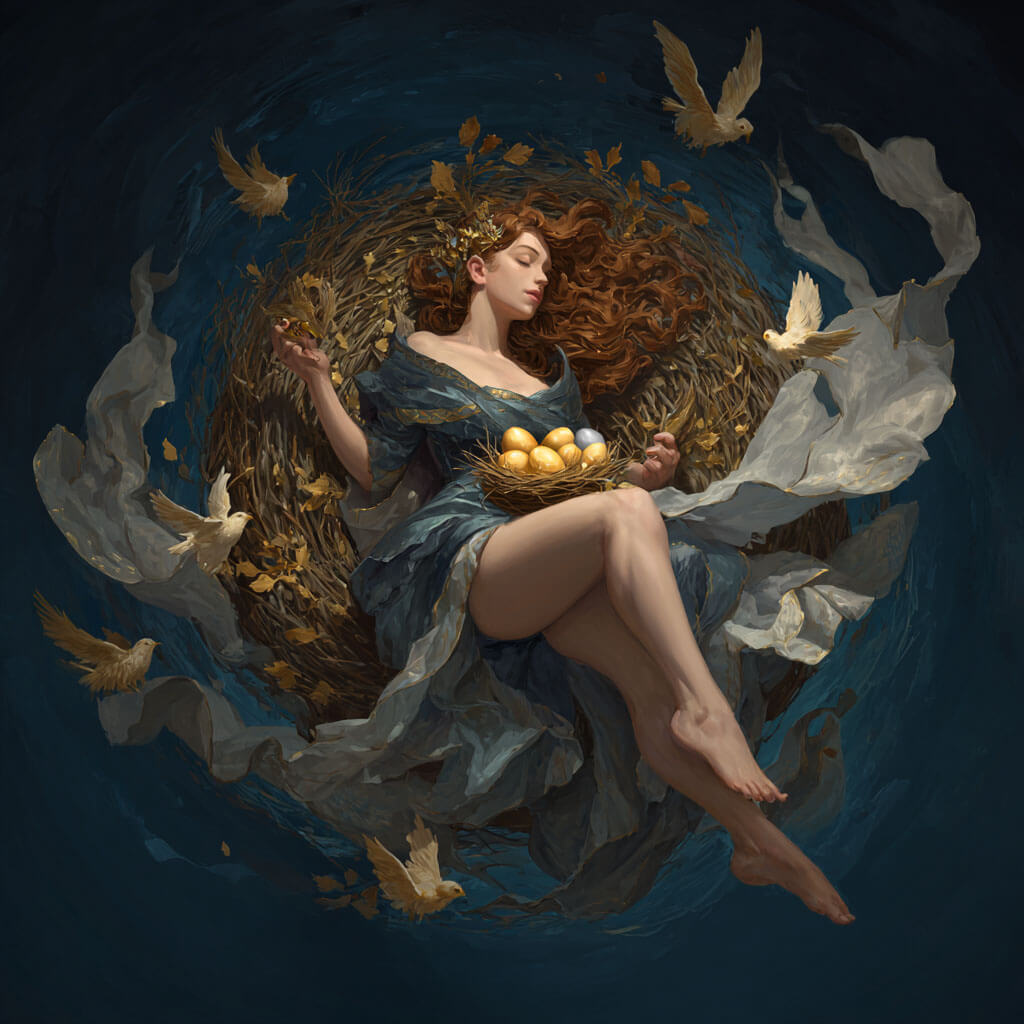
Ilmatar
Maiden of the Air
Goddess of Air and Creation
Karelian / Finnish Mythology
Ilmatar, Maiden of the Air, is the mother of the hero of Kalevala, Väinämöinen, and the Goddess of Air and Creation. In the Kalevala’s creation myth, she begins alone in a void. In some references throughout the Kalevala, she is also called Luonnotar, or the Naturess.
Despite being Väinämöinen’s mother, Ilmatar is also a virgin. However, the sea and the wind impregnate Ilmatar with the hero Väinämöinen. The goddess is a primordial being, existing before the creation of the world.
Before the world forms, she floats in the sea alone until a goldeneye lays eggs on her knee. This egg later hatches, forming the sun, moon, earth, and heavens. After this, she gives birth to her son, who helps construct the landmarks of the world as we know it today.
- Domain: Air and the Sky
- Realm: Celestial Realm
- Symbol: Swan or seabird
- Worship: Prayers, incantations, or offerings
- Offerings: Water, eggs, feathers
- Holidays: Kalevala Day (February 28)
Unlike other deities in Finnish mythology, pagans did not worship Ilmatar. Elias Lönnrot created the character Ilmatar, who is absent from pagan Finnish rune songs. Despite this, she is one of the few deities who appear in detail within the works of the Kalevala.
Mentions in the Kalevala
The first canto, or rune, in the Kalevala deals with the creation of the world and the birth of the hero Väinämöinen. This canto primarily discusses Ilmatar’s struggles and Väinämöinen’s creation of the earth.
Ilmatar once lived in the sky; however, she grew tired of her life there and descended into the primordial sea. As she floats in the endless ocean, the wind (cosmic breath) and the waves impregnate her. She floats in the void of the sea, lonely and filled with discomfort, for 700 years. During this time, she does not give birth.
Eventually, a seabird lays 6 golden eggs and one iron egg on her knee. As the bird incubates its eggs, the heat creates discomfort for Ilmatar. She accidentally drops the eggs in the sea, and they crack. The top of one egg shell forms the heavens, while the bottom of the shell forms the earth. Next, the yolk forms the sun, the egg white forms the moon, and the speckles from the egg shell fragments form the stars in the sky.
Shaping the World
Ilmatar continues to shape the world after its formation. Her footsteps hollow out bays and lakes, straights form where she swims, capes shape where she turns, and ponds pool from her fingerprints.
After the initial shaping of the world, she finally gives birth to her son Väinämöinen, the wise old man. He spends forty summers and winters drifting on the seas, exploring the world until he has finally arrived at the last shore. At last, Väinämöinen sets foot on the earth, wise from his travels.
Väinämöinen begins to shape the land, smoothing hills and valleys, carving rivers, surfacing islands, spreading grass across meadows, and cultivating forests. Next, the ancient sage creates order in the world, calming the winds, allowing gardens to flourish, and using his enchanting songs to make the sun and moon shine brighter.