Haitian Vodou is a religion often misunderstood by others, particularly in the use of an altar. In pop culture, it has the connotation of being “black magic.” However, the truth is far from that. True Vodou is a blend of African diasporic beliefs blended with French colonial Catholicism. How it came to be a religion is a fascinating, brutal, tragic, yet harrowing story of resilience and ingenuity from the enslaved people of Haiti.
The altar plays a pivotal role in Vodou practices, acting as a liaison between the physical and spiritual world. It represents a sacred space which provides healing, protection, and sanctuary. Understanding the importance of the altar sheds light on the faith’s rich cultural values.
How Did Vodou Originate?
Vodou is a syncretic religion that originated in Haiti, with its beliefs derived from the ethnic groups of the Fon, Ewe, and Yoruba. Spanning from the 16th to 19th centuries, Europeans brought enslaved people from Central and West Africa to the Caribbean. In particular, the French colonized Saint-Domingue, which is now modern-day Haiti.
Unfortunately, under French colonial rule, these people were prohibited from practicing their traditional beliefs and religions. However, the underlying religion had similarities to Catholicism. In an innovative approach, the Haitian people masked their worship of old spirits by associating them with Catholic saints. Ultimately, Vodou is a mesh of African Vodun, Catholicism, and indigenous Taíno, the religion practiced by the native Arawak inhabitants of much of the Caribbean.
Vodun’s Similarities to Catholicism
The Fon and Ewe ethnic groups from Benin, Togo, and Southern Ghana practiced the religion Vodun. This religion is a monotheistic belief system in which the supreme God, Bondye, created the universe and governs it from afar. Bondye, however, is too grand to meddle in the affairs of man, so he appointed the loas (spirits) to act as a liaison with humans.
Much like Vodun, Catholicism sees the one true God as distant. Many practitioners venerate saints, who serve as intermediaries between God and humanity. Because of these similarities, it was easy for the enslaved people of Haiti to disguise their religion under French colonial rule. In the process of cleverly masking their religion, Vodou was born in the Caribbean. Loas, spelled lwa in Haitian Creole, in turn, received syncretic associations with saints, making Vodou worship seamless in the New World.
Interestingly enough, many Catholics also set up shrines to their saints. They also leave offerings for these figures called exvotos. The altar quickly became a beacon of hope for the destitute Haitians.
What is an Altar’s Significance?
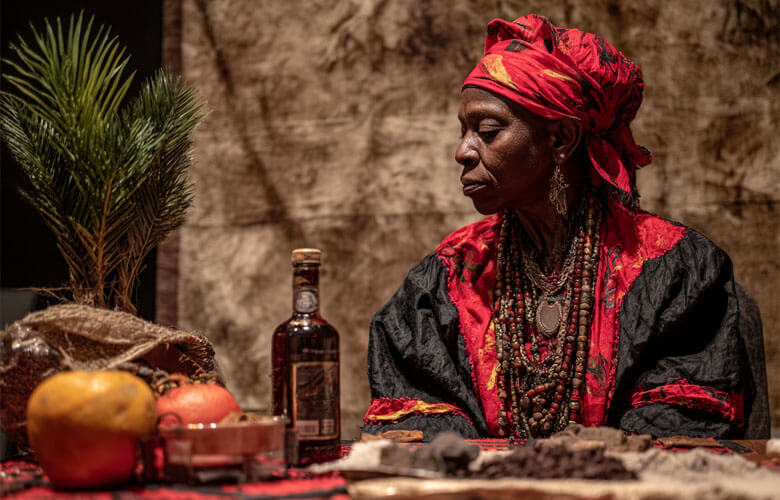
Vodouisants (practitioners of Vodou) often keep an altar, or pè, in their homes. Ounfòs, or temples, also keep altars for the laos as well. A pè serves as a “point of contact” for a lwa, and acts as a crossroad to the spiritual realm.
Mambos and Houngans, priestesses and priests, generally oversee the altars that reside within an ounfò. Families that practice Vodou traditionally follow a lineage of lwas, essentially inheriting the lwas they worship from their ancestors. Because of this, pès at home generally focus on ancestral worship and venerating the lwas of their family.
Once a space where enslaved Haitians could practice their traditional beliefs, the pè became the spiritual powerhouse for Vodou theology. A place of respect (rèpè) and service (sèvis), practitioners leave offerings called “manje lwa,” translating to “food for the spirits.” At these altars, individuals ask a lwa for blessings of guidance, protection, and healing.
The lwa’s role is to hear the prayers and manage the day-to-day affairs of humans. Vodouisants must follow strict traditions, rituals, and proper communication to ensure their interactions with the lwa are from a place of respect and veneration.
Where Are Altars Set Up?
Traditionally, alters should be set up in a clean, elevated space. However, the nature of the altar depends on the specific lwa of worship. In private homes, quiet corners, small tables, or cozy, humble spaces are all suitable locations for an altar.
The purpose of a pè in Vodou rituals is to communicate with lwas, or ancestral spirits, with respect and dignity. Keeping these away from spaces where everyday or “profane” activities occur is essential, except in some instances for lwa from the Ghede family, who prefer raunchy, crude humor.
A pè to Papa Legba might be erected in a doorway or entrance of a space, as he is the guardian of the crossroads. At the same time, temporary altars to Baron Samedi or Baron Cimetière could be set up in cemeteries near the grave of a relative. Many Ghede family altars are set up in cool, dark places, often outside of a residence, to honor the spirits of the dead.
A “hot” (spiritually active) altar must be consecrated and kept pure. The altar opens the gates to the spirit realm, facilitating communication with a lwa. Papa Legba opens the communication, so every ritual starts by gaining his favor.
How to Set Up a Vodou Altar
The Vodou altar is a sacred space, so practitioners must adhere to strict traditional guidelines when setting it up as a place of worship. The process requires respect and personalization. The Vodou altar serves as a beacon to the spiritual realm, enabling vodouisants to facilitate communication with the lwa spirits.
Step-by-Step Altar Setup Guide:
- Choose a suitable space. This space can vary depending on which Lwa the altar will serve.
- Cleanse the space. Scrub the surface to remove dust and apply Florida Water, frankincense, or myrrh to cleanse spiritual energy.
- Cool the foundation. Place a glass of fresh water on the altar to create a conduit for the spirits.
- Heat the altar. Light a candle; the color will vary depending on the lwa’s preference. Candles activate the energy of the space.
- Honor your ancestors. Leave a photograph, artwork, or trinket of a loved one who has passed away near the altar.
- Represent the elements. Provide a representation for each of the 4 elements. For example, incense for air, dirt or stones for earth, candles for fire, and a glass of fresh or sea water.
- Invite the Gatekeeper. Practitioners must first honor Papa Legba to open the gates to the crossroads. Leave a small key, a straw bag, or a small wooden cane near the altar.
- Add offerings to the Lwa. Each lwa has different preferences. Leave objects, such as bells, perfume, food, drinks, or jewelry that the lwa favors.
Setting up the altar is the first step; now, the vodouisant must activate and maintain the spiritual energy of this space.
Activating and Maintaining a Vodou Altar
To ensure the spirits receive the offerings, a practitioner of Vodou must properly activate the altar’s spiritual energy. After activation, they must also maintain the space to prevent the energy from stagnating.
- Announce your presence. Light a candle and knock three times to announce your presence to the lwa.
- Offer libations. Pour three drops of water, or liquor, either on the floor in front of the altar or in a dedicated bowl.
- Recite a prayer. Initiate a heartfelt prayer, first honoring Bondye, then your ancestors, and finally Papa Legba.
- Refresh the space. Change the glass of water frequently. Remove food before it spoils—clean trinkets and offerings to remove “stuck” energy.
What Kind of Rituals are Performed at Altars?
To initiate a ritual at an altar, the practitioner must first clean the space. Next, the person drapes a cloth or handkerchief of the lwa’s favorite color over the space. Offerings and trinkets adorn the altar as the vodouisant starts the ritual.
First, they must venerate Papa Legba to open the crossroads to Ginen, the spirit world. Only after the vodouisant gains Papa Legba’s favor can they make a plea to a lwa.
On a day-to-day basis, practitioners may light a candle and leave water (symbolizing purity), rum, or other food and libations that the lwa prefers. These daily acts of devotion appease the lwa’s desires and show respect.
Formal rituals or larger ceremonies generally involve the guidance of a houngan or mambo. Strict adherence to tradition is essential when conducting these types of rituals. These types of rituals require offerings for the lwa, which can include:
- Food (Manje Lwa): Every lwa has a different taste. Spicy foods, rum, cigars, coffee, pork, and fruits often make up these offerings.
- Libations: Pouring liquids on the ground in front of the offering is common. Water or liquor is a traditional offering for lwa.
- Petitions: Photographs, artwork, or writings can be placed on the altar to honor loved ones and ancestors.
- Consecration: Washing the altar with Florida Water, perfume, or herbal infusions (fey) cleanses it and amplifies spiritual attunement.
Elaborate ceremonies will even seek to summon the spirit to the mortal realm.
Do Lwa Spirits Actually Possess People?
When a practitioner summons a lwa to the mortal realm, this often takes the form of “possession.” This act is one of the most misunderstood aspects of Vodou.
Spiritual possession, called “mounting the horse,” is an act of spiritual union between the lwa and a person. The vodouisant who accepts the lwa becomes one with the divine, receiving guidance, healing, and empowerment from the lwa. The practitioner is referred to as the “chwal,” meaning “horse” in Haitian Creole, while the spirit serves as the rider.
Despite common perception, this act of spiritual possession is not demonic or terrifying. It becomes a uniquely divine experience for the chwal, gaining insight into the spiritual realm. When in this state, the spirit can communicate directly with the community, offering guidance, healing those in need, and reprimanding individuals who neglect their duties.
However, the chwal typically has no recollection of the events after the spirit returns to Ginen. Possession demonstrates the thin veil between the mortal and spiritual realms. While the altar is a significant place where communication begins, the body ultimately becomes the vessel through which the lwa speaks.
The Altar’s Connection to Identity
The altar played a significant ideological role for enslaved Haitians. It allowed them to keep a connection with the ancient heartbeat of Africa, bringing their spirits to the New World. It became a testament of survival, endurance, ingenuity, and resistance.
Despite the necessary disguises of the Catholic saints, the Vodou altar was a safe place where Haitians could rekindle the identity of their former lives. It became a sacred map of history. Ultimately, this identity would lead to the Haitian Revolution, where the rebels gained freedom from their oppressors after a brutal and bloody 12-year war.
Vodou’s Influence in The Haitian Revolution
Practicing Vodou was more than just a religion; it became a national identity. It was one of the few things enslaved Haitians could call their own. This sentiment eventually led to the Haitian Revolution in 1791.
In August 1791, Dutty Boukman, a houngan (Vodou priest), and Cécile Fatiman, a mambo (Vodou priestess), conducted a ritual in a remote swamp called Bois Caïman. The Bois Caïman ceremony served as a tactical and spiritual catalyst for the rebellion against the French.
The Haitian Revolution ultimately lasted 12 years, resulting in an estimated 345,000 to 500,000 casualties. The vast majority of these casualties were enslaved and revolutionary Haitians, with approximately 75,000 French troops, 45,000 to 100,000 British troops, and 25,000 French colonists killed.
Dutty Boukman, the pivotal leader of the revolution, was killed by French soldiers on November 7, 1791, at Fond Bleu. Cécile Fatiman lived a long and full life, dying of natural causes at 112. Haiti became the second independent nation in the New World in 1804 (after the United States of America). It was also the first free Black republic in the Americas.
Related Articles