You may have seen voodoo in movies, TV shows, or other forms of media, but is the portrayal accurate? The answer is flatly no! The concepts often displayed in pop culture voodoo are, in fact, an amalgamation of political propaganda, racial narratives, and early Hollywood horror movie concepts designed to create a false narrative and a maligned perception of a legitimate religion.
To understand the practical workings of this religion, one must be familiar with its origin, history, core concepts, and spiritual practices.
What is Haitian Vodou?
Haitian Vodou is a rich, syncretic, monotheistic religion born out of a variety of beliefs from cultures around the world. The core belief centers on Bondye, the one true God who created the universe. To serve humans, a myriad of lwa act as stewards of the spiritual realm for Bondye.
While there is no accurate headcount, religious scholars estimate millions of people practice Haitian Vodou worldwide. Like most religions, Vodou continues to evolve depending on region, practitioners, and interpretation. Since the religion lacks a single sacred manuscript, it possesses a dynamic quality that allows flexibility among practitioners.
The Origins and History of Haitian Vodou
The current form of Haitian Vodou took two to three centuries to evolve, drawing on beliefs from enslaved people who arrived in Saint-Domingue (modern-day Haiti) between the 16th and 18th centuries. The main beliefs derive from the Fon, Ewe, and Yoruba spiritual traditions of West Africa; however, they also incorporate ideas from Central Africa, Roman Catholicism, and Indigenous Taíno traditions.
Over the generations, beliefs from these different religions gave rise to Haitian Vodou. French colonial authorities initially outlawed it during its formation. As such, Catholic worship became a disguise for religious practices in Saint-Domingue. The lwa entered into a syncretic relationship with counterpart saints in Catholicism.
The Role of Bondye, the Supreme Creator
Bondye, meaning “Good God,” is the supreme deity who created the universe, cosmos, and all life. Contrary to common misconceptions, there is only one true God in Haitian Vodou. However, many don’t pray to him directly, instead using lwas as spiritual mediators to handle the day-to-day affairs of humans.
While Bondye maintains the universal order and its grand design, he remains out of daily human affairs. His presence remains unknowable and distant. In lieu of this, the lwa act as Bondye’s messengers to the mortal world.
Who Are the Lwa in Haitian Vodou?
The lwa serve as intermediaries between Bondye and humanity, each responsible for a distinct domain. These domains include, among others, natural forces, protection, healing, guidance, health, destiny, and fortune.
Practitioners serve the lwa by conducting prayers, offerings, rituals, dance, music, and sacred symbols (vèvè). In return, the lwa provide services from their respective domains; however, only if they are served correctly.
The Relationship Between the Living, the Lwa, and Ancestors
Most lwa predate humans, but this isn’t always the case. A oungan (priest) or manbo (priestess) who becomes venerated during their lifetime can attain the status of lwa after their passing. After the soul’s initial journey is complete, the living venerate the souls of their ancestors or loved ones. When families and larger communities continue worship over generations, the soul can undergo a process of canonization, instilling the power to become a lwa.
Ancestral veneration is an integral aspect of Haitian Vodou. The term “veneration” is used, as “worship” is reserved only for Bondye. After a person’s passing, they must undergo a long journey before reaching Ginen, the Ancestral Homeland. Families and loved ones will venerate the souls of their ancestors, especially at key milestones along this journey.
The living, lwa, and ancestors are thus inextricably intertwined in Haitian Vodou traditions.
What Is a Haitian Vodou Ritual?
A Haitian Vodou ritual is a method of spiritual connection to honor the lwa and create a meaningful relationship with spiritual beings. Unlike pop culture misconceptions, it isn’t a ceremony centered around black magic and hexing others. Instead, it serves as a form of worship for the lwa that govern different parts of the spirit world.
Typically, one ceremony honors a single lwa at a time; however, some ceremonies honor multiple lwa simultaneously. A ritual must be conducted with respect, or the practitioners may face the consequences of breaking tradition.
Haitian Vodou rituals vary depending on the lwa being honored, as each has a preferred method of veneration and a preferred set of offerings. However, most rituals entail five aspects that call the spirit to the mortal realm.
What Are the Steps to Honoring a Lwa?
Honoring a lwa requires strict adherence to their preferences. Failing to do so may invoke the wrath of the lwa instead of their favor, which can bring misfortune, negative relationships, sickness, or other forms of harm.
Unlike other religions, where there are strict guidelines, the steps for honoring a lwa can vary depending on the practitioner, community, lineage, or region. That being said, the most important aspect of a ritual is the application of sincere respect. The spirits can sense imitation or insincerity and may choose not to manifest at ceremonies they deem unworthy.
Traditional Vodou Ritual Steps
A typical Haitian Vodou ritual will entail the following steps:
- Identify the Lwa: Each lwa governs a different aspect of the spiritual realm. First, a practitioner must identify the lwa they wish to honor, what they govern, and how to honor them appropriately.
- Prepare the Space: An altar is generally used as a sacred space, but this can vary between a temple, home, or outdoor space. A lwa might only appear in a distinct location corresponding with the part of the spirit realm they govern.
- Express Sincerity: A ceremony should begin with a sincere gesture, showing the lwa that the practitioner is starting from a place of respect.
- Enact the Proper Dance, Song, or Prayer: Drumming and dancing is perhaps the most common activity in a Haitian Vodou ritual. Each lwa has a unique personality, but songs and dances typically vary based on the nanchon (nation) of veneration.
- Make an Offering: An offering is a gesture of sincerity; therefore, knowing the preferences of a lwa is crucial to provide an adequate offering. Offerings are left as a sign of respect and reverence, often left at an altar or sacred space prepared for the lwa.
- Close the Ceremony: After the ritual concludes, the practitioner must thank the lwa for their presence. A closing dismissal, farewell, or bidding allows the gates lwa to leave and the gates to the spirit world to close. Typically, Papa Legba is responsible for opening and closing the gates to the spirit realm.
The Role of Papa Legba
Papa Legba plays an integral role in most Haitian Vodou rituals. He is the gatekeeper of the crossroads and retains the responsibility to open and close the gates to the spirit world. Most rituals begin by invoking Papa Legba and asking for his blessing to contact a spirit. If the practitioner is sincere, this lwa will abide by the request, connecting them to the spirit realm and the lwa they intend to honor.
When a ritual begins, the practitioner(s) must invoke this lwa to ask for his permission to contact another lwa. Likewise, at the close of a ritual, it is customary to thank Papa Legba and provide a gesture of gratitude for his service.
What are the Core Components of Haitian Vodou Rituals?
Each ritual is unique to honor a particular lwa. However, core components are used across different ritual types and in the request a practitioner makes from a lwa. The purpose of these components is to establish a sacred space, invoke and anchor the spirit, cultivate energy, establish a manifestation, or exchange thanks and honor the lwa.
Invocations and Prayers
Invocations are used to open most Haitian Vodou ceremonies. The purpose of an invocation or prayer is to verbally open the gateway, first to honor Papa Legba, who, in turn, opens the gates to the spiritual realm and clears the path for practitioners to connect with the lwa, or ancestral spirits of veneration.
Prayers and invocations are Vodou ritual components that show respect and sincerity to the lwa, building a foundation for the rest of the ritual to proceed. Typically, an invocation is spoken in Kreyòl Ayisyen (Haitian Creole) or in the native language of the practitioners involved in the ritual.
Manje-Lwa: Offerings
Manje-lwa, literally “feeding the lwa,” is a ritual practice in which followers honor the lwa with their favorite offerings. The type of offering will vary depending on the lwa’s family or nation (nanchon), the practitioners’ specific preferences, and the practitioners’ beliefs. Honoring a lwa varies by region, community, ounfò (temple), and oungan or manbo.
Manje-lwa is a foundational component of most Haitian Vodou rituals, and almost every ritual uses it to show respect to the spirits. It establishes a law of reciprocity while providing an energy source for the lwa to feed upon. Although the lwa don’t literally consume the offering, the gesture is largely symbolic. The principle behind offerings is to provide the lwa with something in return for practitioners’ requests. These requests can be for guidance, healing, luck, protection, or something else.
Offerings are unique to each lwa, but often include flowers, candles, luxury items, alcohol, tobacco, chocolate, food, clairin rum, purified water, or pictures of the deceased.
Vèvè: Sacred Symbols
Each lwa has a distinct vèvè, which acts as a map or beacon during a Vodou ritual. In traditional Haitian Vodou rituals, a vèvè is traced on the floor using cornmeal, ash, flour, or even gunpowder depending on the lwa. Vèvè diagrams are typically reserved for larger rituals where the lwa’s presence is invoked directly into the ceremony. Smaller rituals, such as private ones conducted in homes, might not use this component.
The act of tracing a vèvè on the floor with the proper materials enables an oungan or manbo to focus on meditation and channeling the energy of the lwa. Tracing the vèvè is often accompanied by a sacred rhythm. An asson (sacred rattle) is used during the act, which helps guide the lwa into the ceremony of invocation.
Additionally, altar cloths with an embroidered vèvè can be found in some ounfòs or homes. These cloths adorn sacred spaces ready to receive offerings and honor their respective lwa.
Dans: Dancing, Drumming and Singing
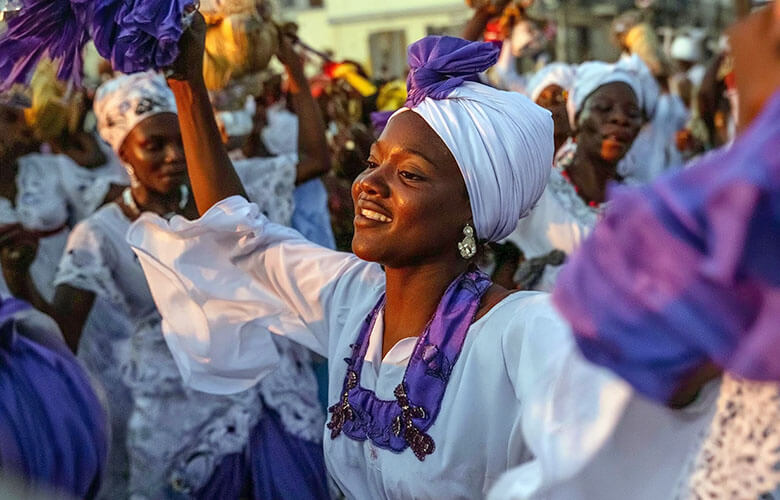
Music and dance serve to focus practitioners’ consciousness and generate the auditory and kinetic energy required to invoke the lwa. It is more than a performance; rhythmic dancing, drums, singing, and music are a form of meditation that focuses practitioners’ energy and invites the lwa to the mortal realm.
Dans is an integral act in most major Haitian Vodou rituals, especially those involving the community. However, much like vèvè tracing, smaller personal rituals, quiet ceremonies, or those focused on meditation might not utilize this ritual component.
As each lwa family is distinct, the drum rhythms will vary between nanchon and specific lwa. Twa Tonbe, Petwo Fran, Yanvalou, Nago, and Kongo Fran are among the most popular, with each relating to a particular nanchon and region of practice. However, in Haitian Vodou specifically, the rhymes of Petwo Fran, Kita, Boumba, and Doki/Makaya/Makanda are the most prominent.
Mounting: Spirit Possession
Spiritual possession is a component of some Haitian Vodou rituals in which the invoked lwa actually enters a practitioner’s body. This is called “moute chwal,” or “mounting the horse.” To understand how this process works, the concept of the soul must be explored as it is perceived in Haitian Vodou.
Every human has two parts of their soul, each playing a crucial role in an individual’s life and afterlife.
- Gwo Bon Ange: The Gwo Bon Ange, “Big Good Angel,” is the actual cosmic life force of a living being. This is the energy Bondye provides to establish life.
- Ti Bon Ange: The Ti Bon Ange, “Little Good Angel,” is the consciousness, willpower, memory, and ego of an individual.
While the Gwo Bon Ange is a shared energy that exists in all life and Bondye, the Ti Bon Ange is unique to an individual.
During the dans phase of a ceremony, the “horse,” or practitioner, prepares their body for the lwa to “mount” them. The practitioner’s Ti Bon Ange steps aside as the lwa enters their body, allowing the spirit to fulfill requests such as healing, blessings, dispute settlement, or offering counsel.
When a lwa mounts a horse, the person, chwal lwa, takes on the demeanor of the spirit possessing them, which includes their mannerisms, gait, personality, vocal tones, and movements. This ritual component usually comes at the climax of the ceremony and requires the oversight of a manbo or oungan.
What are the Types of Haitian Vodou Rituals?
In Haitian Vodou, rituals are a way to establish a bridge into the spiritual realm. Each ritual serves a distinct purpose and requires true intention and sincerity to ensure proper respect for the spiritual realm. Most commonly, a ritual will honor a lwa and make a request of their spiritual domain; requests can include protection, guidance, healing, luck, abundance, or honoring the ancestors.
Vodou rituals vary based on the practicing community; however, the most traditional ones include:
Sèvis: Service, Healing and Cleansing Rites
A Sèvis, literally “service,” is a common ritual that serves a broad range of purposes within a familial line. While there are myriad reasons to perform a ritual, the traditional act falls under a sèvis. Most of the following rituals include a sèvis. Smaller sèvis occur within households and for personal spiritual matters.
The purpose of a sèvis is to honor a spirit, generally corresponding with particular dates in a calendar year. Generally, this type of ritual does not ask the lwa for anything in return, instead honoring them and building a stronger spiritual bond between a spirit and the practitioner or community.
Kanzo: Initiation Rites
A traditional Kanzo is an initiation ritual that binds an initiate to a lwa spirit. Practitioners perform the ritual to mark an initiate’s status change when a honsi (initiate) assumes the title of oungan or manbo. However, priests conduct Kanzo initiation rites throughout a practitioner’s status changes. Not all members who undergo this ritual take on priesthood. There are four main steps of Kanzo initiations:
- Kanzo Senp: A ritual that integrates a practitioner into a ounfò, leading them on the path to becoming an ounsi. The hounsi becomes a dedicated member of the temple, assisting with temple ceremonies and obligations.
- Ounsi Kanzo: This ceremony formally grants the title of ounsi to a practitioner and is generally following the conclusion of the Kanzo Senp.
- Ounsi Lave-Tèt: A cleansing ceremony (washing the head) that improves a practitioner’s life force, bringing mental clarity and enhancing communication with the lwa. This ceremony commits a person to the ounfò, but doesn’t elevate their title.
Furthermore, a Kanzo ceremony occurs whenever a practitioner attains a new rank. The three main ranks an initiate will progress through are:
- Ounsi Kanzo: The title granted when an initiate goes through the ceremony to formally tie them to an ounfò and the spiritual family.
- Oungan / Manbo Si Pwen: A title granted to an ounsi who promotes to a priest or priestess ranking in the ounfò. The practitioner can now perform spiritual work, including borrowing the asson (sacred rattle).
- Oungan / Manbo Asogwe: The highest ranking of a priest or a priestess within an ounfò. Asogwe, meaning “great asson,” enables an oungan or manbo to procure their own asson, and allows them to initiate others into the ounfò.
Fèt: Communal Devotion Ceremonies
A Fèt, festival, is a larger communal ceremony or celebration which includes a variety of ritual components. Generally, multiple manbos and oungans oversee a Fèt. A Fèt can last multiple days as celebrations of specific lwas, holidays, or events occur. Most Fèts encompass the following ritual components in a specific order, depending on the celebration and community conducting it.
- The Priyè Ginen: A prayer or incantation opens the ceremony, honoring Papa Legba and the other lwa involved in the Fèt.
- Tracing the Vèvè: Drawing a vèvè anchors the lwa to the ceremony, providing a guide for them to join the Fèt.
- Dans: Dancing, drumming, and singing build spiritual energy to welcome the lwa to the mortal realm.
- Mounting: A practitioner undergoes spiritual possession, allowing the lwa to communicate directly with the people in the Fèt.
- Manje Lwa: A feast generally follows, but the lwa are also provided with their favorite offerings from the mortal realm to express gratitude for their favors.
Rit Mò: Ancestral and Mortuary Rites
Practitioners perform Rit Mò, a sacred ritual, to guide a deceased individual’s soul through the afterlife. In Haitian Vodou, two distinct components—the Gwo Bon Ange and the Ti Bon Ange—comprise the fragmented soul. While the Gwo Bon Ange returns its energy to Bondye, the Ti Bon Ange must undertake a yearlong underwater journey to return to Ginen, the ancestral homeland. Once a soul reaches Ginen, they transform into an ancestral spirit. Without proper guidance, the soul can become lost in the afterlife.
Therefore, a Rit Mò is more than just a way to honor the recently departed. It is an integral ritual that will allow that person’s soul to reach the proper afterlife. Failure to conduct a proper Rit Mò can result in the soul becoming stuck in limbo. Additionally, it might bring misfortune upon the family of the deceased. Practitioners can invoke souls that become ancestral spirits through Rit Mò in future ceremonies.
Travay Espirityèl: Spiritual Work
Travay Espirityèl ceremonies tend to be smaller, private, and quiet, and they ask a lwa to fix a specific problem. This could be to remedy a dispute, address an illness, seek protection or luck, or make a more specific request, such as getting a job.
Unlike a loud, communal Fèt, a Travay Espirityèl focuses intent on an individual and the specific lwa whose help they need. A manbo or oungan initiates the ritual, ensuring proper respect and formality to engage with the lwa. Community members conduct these rituals as needed rather than following a set schedule.