

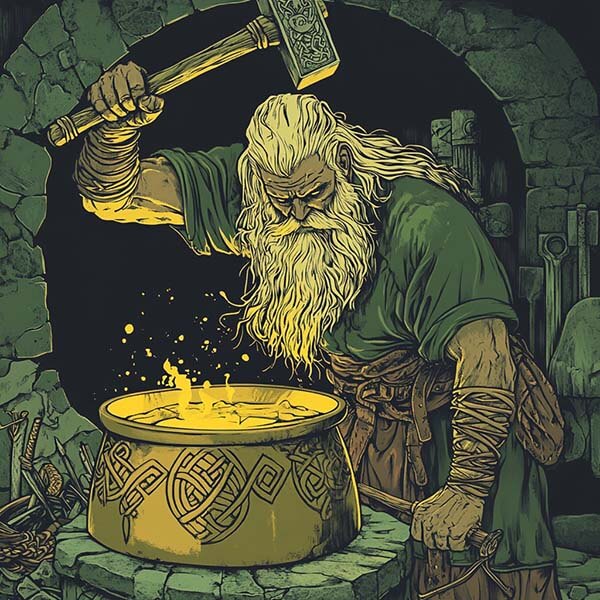
Ilmarinen
Ikiseppä Ilmarinen – The Eternal Blacksmith
Hero of the Kalevala
Karelian / Finnish Mythology
The Eternal Blacksmith, Ilmarinen, is a pivotal hero in Kalevala. He symbolizes creation, creativity, resilience, and consequences. Also known as “The Smith of the Sky”, he is credited in some versions of the Kalevala with forging the Dome of the Sky, which protects the Earth.
However, his most notable feat is creating the Sampo for Louhi, the Mistress of Pohjola. While he is not technically a god, he received divine merit for forging the heavens.
Ilmarinen exhibits a complex array of emotions that symbolize the struggles of humanity. Ultimately, his stories focus on the power of creation, problem-solving, and the complexity of human emotions.
Nicknames
Ilmarinen’s main nickname is “The Eternal Smith”; however, he has a variety of other titles depending on the rune’s variation and the source. His nicknames include the following:
- Taivaan Seppä – Smith of the Sky
- Ikiseppä Ilmarinen – The Eternal Blacksmith
- Sampo-Seppä – Smith of the Sampo
- Taitava Seppä – Skilled Smith
- Rautojen Taitaja – Master of Iron
The Eternal Blacksmith’s Characteristics
Master Craftsman – Ilmarinen is known for his ingenuity and master craftsmanship. His creations display exquisite beauty and magical qualities.
Initially, he was famous for forging the Dome of the Sky. Later, Väinämöinen asks him to create the Sampo for Louhi, Mistress of Pohjola.
Persistence – He is also known for his persistence and determination in crafting and overcoming struggles. His vast knowledge and confidence result in the creation of resourceful tools on the fly and magical items alike.
Resourcefulness – As a master blacksmith, he uses his ingenuity to forge solutions to his problems. These problem-solving abilities serve both mortal and divine beings. Some examples of his creations are the Dome of the Sky and the Sampo.
Creation’s Duality – Despite being a master in his craft, Ilmarinen fails to achieve his personal goal of having a lifelong wife. His struggle conveys the duality of possessing divine skills while still living a flawed life.
Tragic Hero – Ilmarinen’s character represents humanity’s tragedy and flaws. Rewarded with a bride from Louhi for creating the Sampo, his marriage ends in misfortune. Kullervo ultimately kills his living wife, leading to the creation of the Golden Wife. Ultimately, the Golden Wife is cold and lifeless, symbolizing the limits of human creation.
Relics Forged by Ilmarinen
As the Eternal Blacksmith, he is renowned for his legendary forging skills. He is responsible for creating some of the Kalevala’s most powerful relics and magical items.
The Sampo
He creates the legendary Sampo for Louhi in exchange for one of her daughters’ hands in marriage. The Sampo is a powerful magical object resembling a mill that churns out unlimited gold, salt, and grain.
The Golden Wife
With the sorrow of the death of his wife, Ilmarinen decides to craft the Golden Wife. She is a lifelike replica of the Maiden of Pohjola, crafted from gold and silver. However, despite his deft work, the Golden Wife cannot replace his widow. This story illustrates the lesson that money doesn’t always bring happiness.
Ilmarinen’s Forge
From his forge, the Eternal Blacksmith creates divine objects containing power and beauty. His aptitude and ingenuity allow him to construct anything, from mundane to divine. These creations include weapons, tools, and enchanted items, making his work sought out by most throughout the Kalevala.
The Dome of the Sky
After Ilmatar and Väinämöinen shape the Earth, Ilmarinen forges the Dome of the Sky, which provides protection and unity with the Heavens. This feat awards him the renown of being a cosmic craftsman.
Ilmarinen’s Family
While his immediate family receives little mention, his story focuses on his quest to marry the ideal bride. Although this accomplishment eventually leads to immense sorrow and despair.
- Parents: Unknown
- Siblings: Annikki, The Maiden (his sister), unnamed brother
- Spouse: Maiden of Pohjola, Maiden of the Sun
- Children: None
After his wedding, the blacksmith’s stories make no mention of his wife. Yet, the story of Kullervo delves deeper into his wife’s life.
Kullervo is a servant in the household; his story portrays Ilmarinen’s wife as a bitter and vengeful woman. Eventually, during his herding chores, the servant kills her by summoning bears and wolves disguised as cows.
Interactions Throughout The Kalevala
Väinämöinen
Ilmarinen encounters Väinämöinen when he is asked to forge the Sampo for Louhi, the Mistress of Pohjola. Initially, Väinämöinen tricks him into traveling to the northlands; however, Louhi promises him a daughter to be his bride in return.
Later, the two heroes compete to wed the Maiden of Pohjola, in which the Eternal Blacksmith triumphs. Eventually, Ilmarinen, Väinämöinen, and Lemminkäinen venture into Pohjola to steal the Sampo from Louhi.
Louhi, the Mistress of Pohjola
Ilmarinen crafts the legendary Sampo for Louhi. Later, he weds Louhi’s daughter in a celebration that details the creation of beer by Osmotar. The final interaction with Ilmarinen and Louhi occurs when the three heroes plot to steal the Sampo from the Northlands.
Maiden of Pohjohla (Louhi’s Daughter)
After crafting the Sampo, Louhi keeps her promise and gives Ilmarinen her daughter as his bride. The marriage is short-lived, however, symbolizing the tragic nature of human emotions and Ilmarinen.
The Golden Wife
After losing his wife, Ilmarinen sets out to create a replacement for the Maiden of Pohjola. The Golden Wife, a beautiful creation made of gold and silver, turns out to be lifeless and cold. She ultimately symbolizes the duality of human creations.
Lemminkäinen
Lemminkäinen joins Ilmarinen and Väinämöinen on the quest to steal the Sampo. The three heroes travel to the Northlands to retrieve the Sampo from Pohjola. Unfortunately, during this endeavour, Louhi gives chase with her army of the Northlands. As the heroes battle the Mistress of the Pohjola in their ship, the Sampo is lost overboard. The legendary relic remains in Ahtola’s domain to this day.
Realms in Ilmarinen’s Sagas
While Ilmarinen is an inhabitant of Kalevala, his adventures lead him to several other realms. He travels to Pohjola on several occasions, including to forge the Sampo, attend his wedding, and ultimately steal his relic back. The latter leads him to travel across Ahtola as Louhi gives chase. However, the hero spends most of his time in his forge.
- Kalevala (Land of Heroes)
- Pohjola (The Northland)
- Tuonela (The Underworld)
- Taivas (Heavens)
- Ahtola (The Sea)
The Cultural Significance of Ilmarinen in Finland
Finnish nationalism rose in the 20th century, coinciding with the Industrial Revolution. These changes in how Finns perceived the world made Ilmarinen even more iconic. He represents the resilience and perseverance of the working-class Finns.
Two famous statues of this hero stand in Helsinki. The Old Student House has two statues portraying Väinämöinen and Ilmarinen nearby. The Three Smiths Statue depicts three naked blacksmiths hammering an anvil. While this does not specifically reference the hero, it symbolizes his legacy.
Despite his grandeur and heroic stature, Ilmarinen remains a tragic hero in the Kalevala. He is ultimately unable to maintain a stable relationship, which is a folly of his hubris. After his failed marriage to the Maiden of Pohjola, he attempts to forge the Golden Maiden. However, she proves to be cold and unloving.
Ilmarinen’s Stories Throughout the Kalevala
The Eternal Blacksmith plays a pivotal role throughout the Kalevala. He makes up the three main heroes that ultimately go on a quest to steal the Sampo back from Louhi, the Sorceress of Pohjola. While Väinämöinen is arguably the most famous character in the Kalevala, Ilmarinen is a close second, if not tied with the main protagonist.
These are the main Runes where Ilmarinen becomes the focus of the stories. You can also read the full text of the Kalevala and filter each story that features this hero in our Kalevala Interactive Reader.
Rune 9: Origin of Iron
After the hero Väinämöinen is injured from a cut on his leg, an old man on the road offers to render aid. The man claims he has a cure for the wound but requests the origin of iron from the primordial sage in return. Väinämöinen recounts how Ukko conceived three maidens whose milk turned to iron. Iron fled from its brother, Fire, and hid deeply within a swamp.
Upon learning of this, Ilmarinen recovers iron from the marshes and places it in his furnace to forge steel. Iron, promises the blacksmith, won’t harm people. However, unbeknownst to the blacksmith, a hornet of Hiisi injected its venom into the iron, causing it to harden and become brittle, thus becoming suitable for weapons of warfare and death.
The old man condemns the violence caused by iron before using his magical words to stop the severe bleeding. After hearing the story from the primordial sage, the gray-bearded old man has his son prepare a healing salve. The cure consists of oak, herbs, flowers, and other plants, which are first tested on broken trees before being applied to Väinämöinen’s wound.
After regaining his strength, Väinämöinen thanks Ukko for the power of healing, recognizing the wisdom the God of the Sky bestowed upon humans.
Rune 10: Ilmarinen Forges the Sampo
After Väinämöinen returns from Pohjola, he seeks to procure the Eternal Blacksmith’s aid in forging the Sampo for Louhi. The divine craftsman is uninterested in fulfilling the request. Desperate to gain the favor of Louhi, the sage ultimately tricks his friend by showing him an illusion of the moon sitting atop a fir tree. As the blacksmith climbs the tree, Väinämöinen summons a heavenly gust to blow him into Pohjola.
Once there, Ilmarinen agrees to forge the Sampo for Louhi, but only in exchange for her daughter’s hand in marriage. After completing the task, Louhi sends the hero home without the bride, citing that she must remain in the lands of Pohjola to maintain her chores and duties.
Rune 18: The Rival Suitors
Väinämöinen crafts an iron boat to sail to the Northlands, in an attempt to woo the Maiden of Pohjola. Annikki, Ilmarinen’s sister, learns of this and warns her brother. Upon Annikki’s advice, the blacksmith bathes and dresses in his finest clothes. He swiftly prepares his horse and golden sledge and sets off to Pohjola to beat the crafty sage.
Rune 19: Ilmarinen’s Wooing
After Väinämöinen and Ilmarinen both announce their intent to wed the Maiden of Pohjola, Louhi ultimately decides upon the blacksmith, citing his age and craftsmanship as the reason. However, the crafty sorceress doesn’t intend to give her daughter away. Instead, she asks three impossible tasks from the blacksmith. A ruse intended to result in his death before the wedding is set. Unbeknownst to Louhi, her daughter secretly meets with the suitor to guide him in overcoming the obstacles.
First, the blacksmith forges magical iron armor and a plow to plow a field of vipers. Second, he creates a magical iron bridle to subdue the bear and wolf of Tuonela for the sorceress. Finally, he crafts a magical eagle to rake the river of Tuonela with its iron talons and beak to catch the giant pike.
Surprised by his success, Louhi accepts defeat and allows the wedding to proceed.
Rune 20: The Brewing of Beer
In preparation for her daughter’s wedding, Louhi sets out to meet Osmotar to create a magical brew for the extravagant festivities. She slaughters a giant magical ox for the meat, while Osmotar finds the perfect ingredients to create the world’s first beer. The Eternal Blacksmith is formally greeted in Pohjola as the groom.
Rune 21: Ilmarinen’s Wedding Feast
The wedding goes off without a hitch and is described as a joyous and festive occasion. The guests partake in the feast, drinking, singing, dancing, and Väinämöinen gives a speech. The rune describes a husband and wife’s duties in a marriage, and the challenges of starting a new family.
Runes 22-25: The Wedding Rites and Departure
After the grand feast, the Maiden of Pohjola is instructed on the duties of being a wife. She grieves leaving her old home behind, a fact that later becomes a point of contention in the marriage.
Ilmarinen is also instructed on how to be a proper husband and how to respect his wife. He must treat her gently and accept her into his home. The husband and wife then return to Väinölä, where they are greeted by Väinämöinen and their household with celebratory songs.
Runes 31-36: Tragedy with Kullervo
Ilmarinen acquires an orphaned servant, Kullervo, to help around the smith. However, his wife is bitter toward the child and imposes undue burdens on the servant. She bakes a brick into his bread, causing his family’s knife to break when it cuts into the loaf. Kullervo, already fed up with this mistreatment from the blacksmith’s wife, becomes enraged when his only relic from his slain family is destroyed.
He hides the herd of cows he’s tasked to watch over, and summons magical bears and wolves disguised as the cattle. After bringing them back to the house for Ilmarinen’s wife to milk, the animals rend the woman limb from limb, and Kullervo flees his servitude to return to his homeland.
Rune 37: Ilmarinen’s Bride of Gold
Distraught from the death of his wife, the Eternal Blacksmith begins forging the perfect bride. After months of laboring, he crafts the Golden Bride out of gold, silver, and gems. However, she turns out to be cold and lifeless, refusing to sleep next to him, not a suitable replacement for his late wife. He proffers the bride to Väinämöinen, who rejects the offer despite being unwed. This rune teaches the lesson that gold and silver cannot replace the feelings of a genuine relationship.
Rune 38: Ilmarinen’s Fruitless Wooing
Desperate to remarry, the blacksmith heads back to Pohjola to woo the younger sister of his late wife. After her rejection, Ilmarinen kidnaps the woman and attempts to bring her home. In a fit of protest, the maiden mocks and insults the blacksmith during the journey. Fed up with her scorn, Ilmarinen uses his magic to transform the maiden into a seagull (lokki).
Upon his return, the blacksmith seeks out Väinämöinen to tell him of the prosperity Pohjola enjoys from possessing the Sampo.
Runes 39-43: The Quest for the Sampo
Initially, Väinämöinen and Ilmarinen set sail for Pohjola to retrieve the Sampo from Louhi, believing it should bring prosperity to Väinölä rather than the Northlands. Along their journey, they encounter Lemminkäinen, who agrees to join them because of his own grievances against Louhi and Pohjola.
Along the way, a giant pike crashes into the boat, which Väinämöinen uses to create the first kantele (harp). All three heroes attempt to play it; however, Väinämöinen is the only one who can make it produce a beautiful sound. As they arrive at Pohjola, the sage uses his newfound kantele and magic to lull the inhabitants of the kingdom to sleep, allowing them to sneak into the mountain vault to steal the Sampo.
Upon their retreat from Pohjola, Louhi discovers the Sampo is missing and transforms into a giant eagle, allowing her army to ride upon her back as they pursue the heroes’ boat. In the battle over the sea that ensues, the Sampo is cracked and slips into the sea, forever lost to the realm of Ahtola. Despite the Sampo being lost, Louhi and Väinämöinen manage to bring a shard of the relic back to their respective lands, but it fails to produce the wealth and abundance of the complete Sampo.
Runes 47-49: Forging the Fake Sun and Moon
Louhi becomes enraged by the betrayal of the heroes of Kalevala and seeks revenge upon the inhabitants of Väinölä. She steals fire from the lands, unleashes plagues and disease, unleashes a giant bear, Otso, the Honey Eater, and hides the sun and moon. After the world is plunged into darkness, Ilmarinen tries in vain to recreate the Sun and Moon with gold and silver.
After Väinämöinen discovers the location of the hidden celestial bodies, Ilmarinen forges spears and chains to wage war with Pohjola. Louhi, wise and recognizing the power of the great blacksmith, surrenders the Sun and Moon, with the understanding that her quest for revenge just brought sorrow and suffering upon others.
Frequently Asked Questions
What mythical artifacts did Ilmarinen forge?
Ilmarinen, the Eternal Blacksmith, is renowned for his forging skills. His magical artifacts help explain the natural world and teach humanity lessons.
- The Dome of the Sky: During the creation of the world, the Eternal Blacksmith forges the Dome of the Sky out of iron, with gems making up the stars. Its purpose is to contain the mortal world under the heavens (Taivas).
- The Sampo: After being tricked by Väinämöinen, he forges the Sampo for Louhi. This relic provides her kingdom of Pohjola with unlimited resources and wealth. Eventually, the heroes attempt to retrieve this relic, but it gets lost at sea. As it produces salt for one of its functions, this is the reason why the sea is salty.
- The Golden Maiden: After the death of his wife, he attempts to forge the perfect woman. He creates her out of gold, silver, and jewels. Although his craftsmanship is impeccable, she turns out to be cold and unloving. This lesson warns of the dangers of replacing human warmth and interaction with wealth.
What does the Sampo do?
The Sampo is a magical mill that creates an unlimited supply of resources. It has three sections: one for creating grain and flour, another for creating salt, and the last for creating gold. Possessing this artifact makes Pohjola a source of never-ending wealth and prosperity.
How did Väinämöinen trick Ilmarinen into forging the Sampo?
After promising Louhi he'd create the Sampo, Väinämöinen asks Ilmarinen for help. But the blacksmith refuses. Next, Väinämöinen lies to his companion, stating the sun and the moon are stuck among the branches of a tree. As the blacksmith climbs the tree to investigate, Väinämöinen summons a strong wind with his magic and blows him into Pohjola.
Did Ukko help Ilmarinen forge the Sampo?
Yes, Ilmarinen is the person responsible for forging the Sampo; however, his first attempts are unsuccessful. He calls upon the "Old Man," or Ukko, to bestow his heavenly force to bless the fire. This request results in a divine blessing on the forge's fire, granting it the qualities needed to complete the forging. While Ukko doesn't play a hand in making the Sampo, he helps the blacksmith get the right kind of fire to complete the task.
What were Ilmarinen's 3 Impossible tasks to win Louhi's daughter's hand in marriage?
When Ilmarinen sought the Maiden of Pohjola's hand in marriage, her mother, Louhi, assigned him three nearly impossible tasks. These were:
- Plow a field of vipers. To protect himself during this feat, the Eternal Blacksmith forged a magical suit of iron and an iron-tipped plow to allow him to complete this task unharmed.
- Capture the Bear of Tuonela and the Wolf of Manala. To subdue these terrifying creatures from the land of the dead, the Eternal Blacksmith crafted a magical iron chain, bridle, and bit.
- Catch a pike from the River of Tuonela. The river of the dead is a treacherous place. He knew he couldn't complete this task with standard fishing tackle. Instead, he forged a giant, magical, golden eagle with talons of iron and a beak of steel. After a few passes over the river, the eagle was able to snatch the pike out of the River of Tuonela with its talons.
Who did Ilmarinen marry?
Ilmarinen marries the Maiden of Pohjola, Louhi's beautiful daughter. She protests the wedding, as she has to leave her land, and becomes bitter as his wife in Väinölä.
Did Ilmarinen have children?
No, Ilmarinen and his wife never had children. However, they took on Kullervo as a servant boy to help them around the smith. Despite his help, the Maiden of Pohjola is cruel to the boy and plays tricks on him.
What happened to Ilmarinen's wife?
Kullervo, their servant, ultimately kills Ilmarinen's wife. After breaking his knife, the only memento from his slain family, Kullervo becomes enraged. He summons a pack of bears and wolves disguised as cows, tricking her into tending to them. The creatures maul the blacksmith's wife as Kullervo escapes.
What was the lesson of the "Golden Bride"?
After the death of his wife, the Eternal Blacksmith attempts to forge a perfect wife from gold and silver. The "Golden Bride" is cold and unloving. Despite his skill, he feels more alone than ever. This story teaches the value of genuine companionship over material wealth.