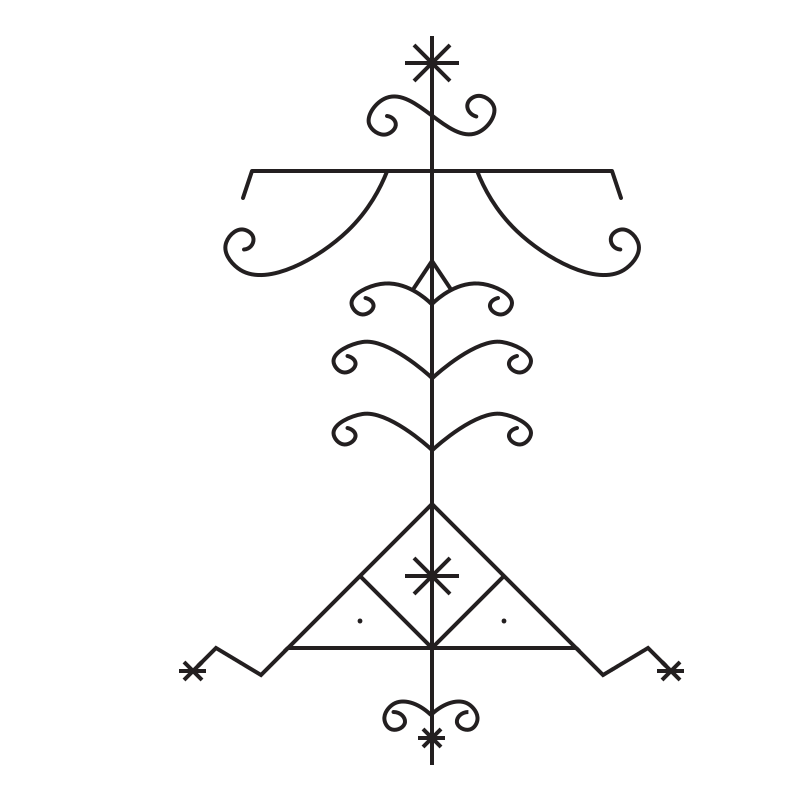


Ogou
Haitian Vodou
Loas of War, Ironworking, Justice, and Leadership
Warrior Loas of the Nago Nation
Ogou, also Ogun or Ogu, is a warrior spirit (loa) who presides over war, warriors, iron, fire, blacksmithing, and rum making. Ogou is not a singular loa, but rather a family of loa that represent the warrior spirit. Origins of this loa stem from the Yoruba Orishas (spirits); however, the beliefs found their way to Haiti during the slave trade.
Ogou was a significant influence on the Haitian people during the Haitian Revolution. While the loa did not participate in combat, the warrior spirit raised the morale of the people during the revolution. In addition to warfare, the Ogou represent honor, respect, order, justice, and discipline.
In addition to his contribution to the Haitian Revolution, Ogou has a host of followers from trade backgrounds. Aside from warriors, some of these include hunters, blacksmiths, rum makers, technologists, and even drivers.
Ogun’s Origin from the Yoruba Orisha
Orishas are spirits, similar to loa, in the Yoruba religion. Ogun, as the Yoruba people called him, is a renowned warrior spirit. He is said to be the first king of Ife, before becoming a primordial orisha.
As a king, he commanded respect from his followers. However, when some chose not to respect the king, he subsequently slaughtered them. Afterwards, he ended his life with his own sword and left the mortal realms. His followers believe that his spirit returned to the earth, rather than disappearing altogether. To this day, Ogun continues to lend his assistance to those who call upon his name.
Additionally, the Yoruba believe he is the first orisha to clear a path to earth, using an axe and a dog for help. This path is significant as it would allow other orishas to enter the mortal realm.
Manifestations of Ogou
Ogou is a family of warrior spirits of the Nago nation, rather than being a single spirit. Consequently, there are various manifestations of Ogou in Haitian Vodou. Regardless of his manifestation, the Ogou family represents warriors, iron, discipline, order, war, and diplomacy. Likewise, these aspects tend to favor the colors red and blue, which represent the Haitian flag.

Ogou Feray
The quintessential warrior loa, Ogou Feray, sometimes called Ogoun Ferraille, is the spirit of a great army general. He represents military strategy, strength, authority, and ironworking, and is also a symbol of liberation for the Haitian people. Furthermore, his symbolism played a significant role in the people’s morale during the Haitian Revolution. This loa exhibits a hot temper and strict martial discipline.
One of the most influential ideologies of the Haitian Revolution was harnessing the power of iron. Once thought to be a tool of slavery due to iron shackles, iron weapons such as machetes and hoes became weapons for the people to fight the colonial powers.
Ogou Feray prefers the colors red and blue, which represent the Haitian flag. His symbols include the machete, representing warfare, and an anvil, representing ironworking. This loa is commonly depicted at a forge, where he transforms raw materials into iron tools. Likewise, as a symbol of transformation, he spurred the Haitian people to create change in their country.
In some cases, Feray is the husband of Ezili Dantò and the cause of the rivalry between her and Erzulie Freda.
Symbols:
- Machete
- Anvil
- Fire
- Cuban cigars
Offerings:
- Rum set alight
- Tobacco
- Spicy food
Attributes:
- Discipline
- Authority
- Liberation
- Strength
Saint James the Greater is the syncretic counterpart for this aspect, a patron saint for soldiers. Ogou Feray acts with a stern demeanor and a commanding military presence. As such, he is called upon to address matters of politics and leadership.

Ogou Badagri
Unlike the previous manifestation, Ogou Badagri, or Ogoun Badagris, is a high-ranking General and Statesman. His calmer demeanor than his brother Feray makes him ideal for handling tasks of military intelligence, politics, and leadership roles.
This aspect favors justice, honor, and truth, leading many to seek his counsel in times of legal need. As a general, Badagris’ preferred colors are red, dark green, and khaki, representing a military uniform. He is a diplomat at heart, more suitable in a courtroom or war room than on the battlefield.
Badagri’s origins date back to Badagry, Nigeria, an icon symbol of the “Door of No Return” in the transatlantic slave trade. As such, this symbolism also reinforces his nature to strive for justice.
Symbols:
- Fire
- Intertwined swords or machetes
- Weapons of protection
- Salutes
- Watchtowers
Offerings:
- Piman rum
- Cigars, especially high-quality ones
- Black coffee
Attributes:
- Calm demeanor
- Justice
- Diplomacy
- Strategy and tactics
- Defense
Badagri’s Catholic syncretic counterpart is Saint George, who is often depicted slaying a dragon. His appearance exudes authority, strategic planning, and the level-headed approach necessary to win. Furthermore, he is often depicted limping or using a cane, representing his tenure of battles.

Ogou Balendjo
Often called the “Wet Ogou,” Balendjo is one of the few Ogou aspects that focuses on water instead of fire. His domain crosses that with Met Agwé, and he’s responsible for protecting sailors, seafarers, and those traveling by the sea. Likewise, his appearance is that of a naval admiral, exuding confidence, wisdom, and experience.
Ogou Balendjo’s demeanor is that of a calm, deliberate elderly gentleman. He is a loa of healing, herbalism, and medicine, along with maritime authority. While his fiery spirit is scarce compared to his brothers, this loa commands quiet respect through patience, calm, and authority.
While Badagri is considered a general, Balendjo is compared to an officer or admiral of the navy. Additionally, Balendjo prefers the colors blue and white, a slight contrast from the other Ogou, who generally prefer red. Like Feray, he is also associated with Saint James the Greater.
Symbols:
- Water
- Salt
- Immamou
- Machete
- Scalpel
Offerings:
- Rum
- Red wine
- Champagne
- Black licorice
- Cigars
- Shells
Attributes:
- Healer
- Herbalist
- Discipline
- Protector
- Law-keeper
Ogou Balendjo represents strength, patience, and acts as a guardian to travelers and traditions. Depicted as an elderly man, this loa is also a keeper of knowledge, order, and traditions.

Ogou Batala
Also called Gran’ Batala, this loa is a commanding warrior spirit in the Nago nation. This warrior spirit is a combination of Obatala, the supreme deity of the Orisha in Yoruba beliefs, and the Ogou warrior spirits. While a mighty warrior, this loa has a calmer demeanor than others in the Nago nation, such as Feray. Batala often takes on the role of a mediator, providing diplomatic guidance and governance of laws.
When an Ogou spirit becomes too hot or aggressive, practitioners may invoke Batala to help calm the situation. Because of this, many refer to him as the “Father of Soldiers.” He is direct, stern, pragmatic, and logical in his decision-making. These attributes represent his deep values of leadership and wisdom. Furthermore, Vodouissants call upon Batala when diplomacy holds significance over warfare.
While most Ogou spirits fall in between the Petro and Nago families, Ogou Batala’s ties are with the Nago and Rada traditions. His association with the Rada family is indicative of his calmer nature, allowing him to make critical judgments without losing his temper. As such, he prefers the colors red and white, symbolizing his warrior spirit combined with extensive wisdom and discipline.
Symbols:
- Spear
- Opaxoro (a sacred staff)
- Silver (instead of iron)
- Mountains
- Air
Offerings:
- White rice
- Boiled yams
- Eggs
- White rum
- Dry gin
- Cigars
Attributes:
- Protector
- Commanderv
- Leadership
- Justice
- Self discipline
- Ethics

Ogou Shango
In Nigeria, Ogou and Shango are two distinct spirits. However, in Haitian Vodou, they merged into a single entity. This loa rules over lightning, divine justice, and transformation, leading to his portrayal as an executioner or a warrior king. Shango manifests royalty and raw energy, as if emanating from a storm.
Ogou Shango represents the elements of fire and electricity, preferring the colors white and red. His demeanor is that of a proud, commanding, and swift leader, capable of making quick decisions under pressure. Additionally, this loa has a disdain for cowardice and disrespect.
Ogou Shango in Haitian Vodou is syncretic with St. Michael the Archangel, as both represent celestial warriors. Furthermore, many view this loa as a warrior-magician, capable on the battlefield while wielding magical abilities to defeat his foes.
Symbols:
- Oshe (double-headed axe)
- Iron clamps (for forges)
- Machete
- Pyè Tonnè (thunderstones)
Offerings:
- Piman (spicy rum)
- Clairin
- Spicy food
- Pomegranates
- Red apples
- Cigars
Attributes:
- Stern
- Disciplined
- Judge
- Executioner
- Warrior King

Ogou Panama
While not particularly a loa associated with war, Ogou Panama embodies the working spirit of Haitians abroad. Ogou Panama’s popularity rose during the construction of the Panama Canal, which saw a massive labor force of Haitians.
Panama is a poignant aspect of the Ogou family for many Haitians. He symbolizes the struggle of hard work and perseverance under harsh conditions. Unlike most of the loas in Haitian Vodou whose origins stem from West African beliefs, Panama is a newer spirit, unique to the Haitian labor contribution of the Panama Canal.
Ogou Panama represents the labor class of Haitians and is a tragic leader to many. Despite his strength, even the fiercest warriors can succumb to disease and death. Most notably, this loa represents the hard work of Haitians abroad in foreign lands.
Destitution While Building the Panama Canal
Conditions were abysmal during the construction of the Panama Canal. Roughly 25,000 people died during the construction of this infrastructure process. Most of those succumbed to disease, particularly yellow fever and malaria.
The majority of labor came from Afro-Caribbean people of the West Indies. Most notably, workers came from Barbados, Jamaica, and Haiti. Due to the extreme conditions, Ogou Panama became a loa the workers looked up to. This loa dons a Panama hat and is commonly associated with leadership, diplomacy, and strategy. Additionally, he walks with a cane or a broken stick, representing the exhaustion of the workers who worship him.
Symbolically, “the falling hat” is a metaphor for Panama. In this analogy, the iconic Panama hat falling to the ground represents the sudden death many laborers faced during construction. This imagery is symbolic of the downfall of even the greatest warrior.
Symbols:
- Panama Hat
- Machete
- Foreign lands
- Passports
- Red Mouchwa (scarf)
Offerings:
- Rice and beans
- Black coffee
- Piman or Barbancourt rum
- Fried plantains
- Yams
- Boulette (Haitian meatballs)
- Cigars
Attributes:
- Hard work
- Strength
- Human mortality
- Perseverance
- Travel
- Leadership

Ogou Je Wouj
Ogou Je Wouj (Red Eyes) is one of the fiercest and most feared loas in the Nago Nation. He represents a warrior at the prime of battle, and the primal rage felt by enslaved people. While not inherently evil, this loa is among the most dangerous in the Petro family.
Vodouissants call upon Je Wouj when the total destruction of an enemy is necessary. His actions are swift and decisive when he carries out his sentences. Afterwards, he is said to wash his hands clean of blood in flames, without suffering burns. This loa is closely associated with heat, be it in battle or from fire.
His most distinguishing features include his fiery, piercing gaze, bloodshot eyes, and aggressive gestures. Unlike the others in the Nago Nation, this Ogou does not take on a military appearance; instead, he appears as a primitive, raw predator, wearing battle-torn clothing or rags. His proclivity for crimson, dark red, and black makes up the clothing he wears when manifested.
Symbols:
- Bloody machete
- Broken shackles
- Fire
- Iron spikes
Offerings:
- Piman
- Flaming Rum
- Black coffee
- Cigars
- Griot, or other fried meat
Attributes:
- Vengeance
- Justice
- Protection
- Terror
- Raw Power

Ogou Yansan
Ogou Yansan, often called the “Warrior of the Winds”, is a turbulent loa associated with hurricanes, storms, and fierce winds. He is also one of the few Ogou, or Nago Nation loas, who can navigate graveyards successfully. Because of this, he is also seen as a protector of the spirits, guiding souls through the cemetery towards the afterlife.
He is partial to the colors red, burgundy, purple, and black. His demeanor is that of a stoic, disciplined warrior. Although Yansan originates from Yoruba beliefs, she manifests as the female spirit Oya in West Africa and Brazil. However, in Haitian Vodou, all the Ogou spirits manifest in male form.
Yansan’s female warrior counterparts would be closely associated with Ezili Dantò and Marinette. These female loas embody the warrior spirit of women to the Haitian people.
Symbols:
- Drums
- Horses
- Storms
- Lightning
- Machetes
Offerings:
- Griot, or cooked meat
- Plantains
- Rum
- Spicy foods
- Coffee
- Cornmeal
Attributes:
- Justice
- Protection
- Strength
- Breaking barriers
- Leadership
Vodou Influence on the Haitian Revolution
The Haitian Revolution kicked off after the Bois Caïman Ceremony on August 14, 1791. While significant planning took place before this ritual, it acts as a symbolic marker for the start of the insurrection by the enslaved people of Haiti. Dutty Boukman, a Vodou Houngan from Jamaica, and Cécile Fatiman, a Haitian Mambo, headed the ceremony. Together, they initiated the Vodou ritual by sacrificing a black Creole pig, invoking Ezili Dantò and Ogou Feray to aid them in overthrowing the French colonizers.
The Struggle for Independence
While the Vodou ritual is seen as the spark of the Haitian Revolution, the leading figure in this movement was Toussaint Louverture, a formerly enslaved person who purchased a plantation, becoming a slave owner himself, before transitioning into the leading abolitionist figure in the Caribbean.
After the initial rebellion in 1791, Louverture played a pivotal role in negotiations between the Haitian rebels and the French. In exchange for releasing their French captives, Louverture bargained to ban the use of whips and provide enslaved people an extra day free of work. Later, between 1793 and 1794, he allied with the Spanish in the region, who were at war with France. He became renowned as a formidable military leader, negotiator, and nation-builder.
Louverture would go on to form a trade alliance with the United States and Britain and become the highest-ranking officer of Saint-Domingue (now Haiti) in 1797. Finally, in 1801, the entire island was conquered by Louverture and his forces, providing abolition to the enslaved people. He would go on to reintroduce a plantation like system, with forced labor replaced by paid labor.
Haiti Becomes a Historical Republic
However, the war with France was not over. Louverture was captured and extradited to France in 1802 before subsequently dying in a French prison the following year in 1803.
Ultimately, his lieutenant, Jean-Jacques Dessalines, took over the revolution, finally earning Haiti’s independence in 1804. Haiti was the second nation in the Americas to gain its independence, and the first free Black republic.
While Toussaint Louverture was a tumultuous figure, he is often associated with the various aspects of Ogou. As a strong military leader, statesman, diplomat, negotiator, and entrepreneur, he carried the spirit to resist oppression and struggle to build a better future.