

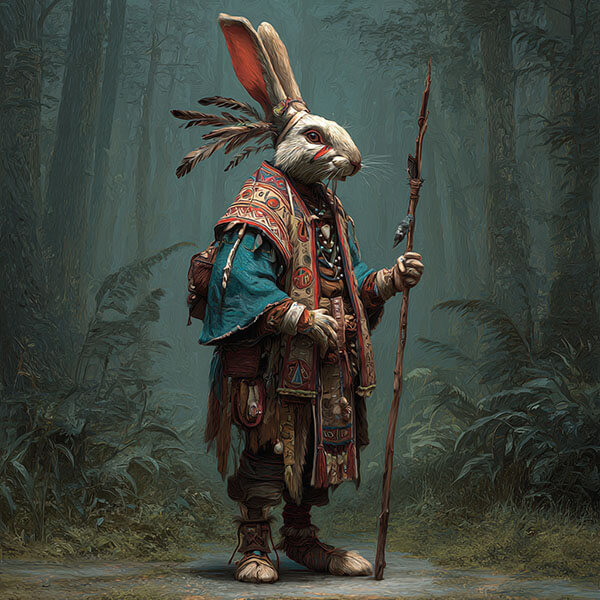
Jistu (Tsisdu)
The Trickster Rabbit
Cherokee Mythology
In Cherokee folklore, the Rabbit symbolizes wit, cleverness, agility, survival, and mischief. Jistu, sometimes Jisdu or Tsistu, is the personification of the rabbit spirit in Cherokee folklore tales. He is known to use his cleverness to trick other animals and appears in several central stories.
Each story in Cherokee folklore provides a lesson for the people. These stories are ways to instill values within the community. In the majority of his tales, Jistu’s antics teach children the value of truth and the consequences of their actions. While not a malicious figure, Jistu pranks his fellow animals for humorous purposes. However, these often create unintended consequences.
While Jistu is the Cherokee version of the Trickster Rabbit, it is not an isolated concept to the Cherokee Nation. The Muscogee (Creek), Chickasaw, Choctaw, and others in the Southeastern United States view rabbits as trickster animals. The Rabbit also symbolizes the value of wit over brawn, underscoring intelligence.
Stories Involving Jistu’s Antics
Jistu is a central figure in Cherokee folklore. While many of the other animals are not fond of him, his antics teach lessons, particularly to children. Jistu has a clever but manipulative persona. This persona often leaves him at odds with the other animals as he uses his wit to trick or outsmart them.
Jistu tricks others partly for humor, but in other stories, he also does so to survive. The humorous aspects often teach the value of truth over deceit. At the same time, the survival stories teach how the brain can overcome brawn.
Why the Possum’s Tail is Bare
The Possum once had a majestic and bushy tail. He showed off and gloated about his glorious tail every chance he got, so much so that the other animals became jealous, particularly the Rabbit, who had no tail.
Jistu, the Rabbit, devised a plan to put the Possum in his place. He invited the Possum to a council to dance with all the other animals. The Possum accepted on one condition: that he could showcase his tail in a special seat at the council.
Happily, the Rabbit agreed, but he told the Possum he should have his tail wrapped for his special seat at the council. Jistu, the Rabbit, sent Cricket to attend to Possum’s tail. Cricket was an expert hair cutter, often known as “the barber.”
Cricket began wrapping Possum’s tail in a red ribbon. However, as he did so, he clipped the hair down to the roots. Carefully wrapping and clipping, Cricket wrapped the entire tail with red ribbon.
At the council, the Possum waited for his turn to dance. Once it came up, he unwrapped his majestic tail and began his dance. Possum proclaimed, “See my beautiful tail!” as he danced around the circle. The other animals began to shout at him. Possum continued this for two more laps around the circle.
Finally, the Possum began unwrapping the red ribbon to really show off his majestic tail. As the ribbon came off, so did all the hair, leaving his tail bald and scaly. The other animals roared with laughter. Confused, Possum looked down at his tail, bare of hair; it resembled that of a lizard’s tail now.
Possum was so embarrassed that he fell on the ground and played dead.
Lessons of Humility
This lesson teaches about jealousy and humility. Vanity can lead to disaster among the community, creating jealousy and disdain among members. Hubris is met with humility in this story, showing how the cunning Jistu’s mischief humiliated the arrogant Possum.
Furthermore, this story explains why the Possum’s tail is bare and why he “plays dead” in stressful situations.
How the Deer Got His Horns
A long time ago, neither the Deer nor the Rabbit had horns. Both were known for their speed and agility. Curious, the other animals arranged a race to see who was faster. As a prize for the race, they crafted a wondrous set of antlers. Deer and Rabbit agreed to the race and the prize.
On the day of the race, the Rabbit decided he was at a disadvantage as he did not know the land. He requested to scout the race track before it started. Naively, the other animals agreed; it should do no harm after all.
When the Rabbit took too long to return, the animals sent a scout to find him. The scout quietly came upon the Rabbit gnawing at the brush to clear a path to the finish line. Inconspicuously, the scout returned to the animals with the news.
Once the Rabbit returned, the animals confronted him about why his scouting had taken so long. After lying, the animals presented the evidence against him. Ultimately, they disqualified Rabbit from the race and awarded the antlers to Deer. He wore them proudly ever since.
As a punishment, the other animals forced Rabbit to clear the forest or brush by gnawing it ever since.
Lessons of Integrity
This tale teaches the community the importance of truth and the consequences of deceit. Integrity is profoundly more important than winning. Failing to act honorably can lead to punishment by the community.
How the Rabbit Stole the Otter’s Coat
All the animals come in different pelts and coats, varying in length and color. They always debated who among them had the best coat. One day, they decided to hold a council to award a winner. Many heard Otter had a beautiful coat, but he lived far away. They hadn’t seen his coat in a while, but wanted to summon him to the council.
Mischievously, the Rabbit offered to find the Otter and bring him to the council. He ventured out to find Otter with ulterior motives. When Rabbit found Otter, his coat was soft, dark, and wonderful.
Since the Otter was unfamiliar with the lands, the Rabbit told him he was there to escort him to the council. Gladly, the Otter followed the Rabbit.
On the first day, the Rabbit collected wood and kindling on his back. The Otter asked him what it was for, and the Rabbit told him it was to keep them warm at night.
After eating dinner, Rabbit got a stick and began carving a paddle out of it. Curious, Otter asked him what the stick was for. The Rabbit lied and said it gave him good dreams when he slept with a paddle under his head.
Next, the Rabbit began clearing brush towards the river. Once again, the Otter inquired why he was doing this. The quick-witted Rabbit told the Otter, “This is Di’tatlaski’y” (The Place Where it Rains Fire). If it begins to rain fire in the night, make a run for the river. But you should hang your coat up to ensure it doesn’t get burned.”
Once the Otter fell asleep, and the fire burned to embers, the Rabbit used the paddle to fling the embers in the air. He shouted, “It’s raining fire! To the water!” Quickly, the Otter followed directions and ran to the river.
The mischievous Rabbit then jumped into Otter’s coat and bound away to the council. Ever since, the Otter has lived in the river. When he arrived at the council, he was so bashful that he kept his face covered with his paws.
Curious, the Bear went to pull the Otter’s hand away from his face. He found a startled Rabbit, who attempted to flee. Bear took a swipe at the Rabbit, pulling off his tail, but the Rabbit managed to scamper away.
Lessons of Deceit and Kindness
This story tells why the Otter lives in the river and why the Rabbit has no tail. The deceitful Rabbit may have stolen a better coat, but it comes at the cost of his tail. Additionally, this tale explains why the Rabbit is so skittish and quick to run away.
In turn, the Otter was too naive and quick to believe others. This folly led to the loss of his coat. While trust is important, it is essential not to place your trust in others without good reason.