

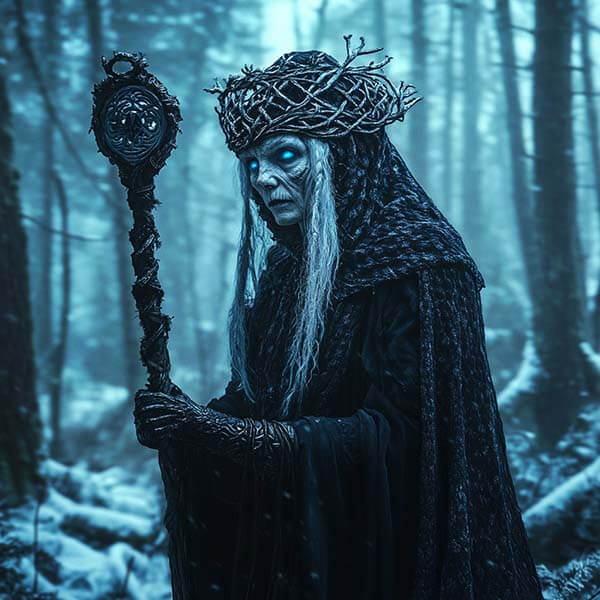
Louhi
The Mistress of the Pohjola
Antagonist of the Kalevala
Karelian / Finnish Mythology
Louhi is the ruler of the Pohjola, a magical land in the North of Finland which closely resembles Lapland. She is a powerful sorceress who fiercely defends her lands and people. Her role in Kalevala is of the antagonist who sends the heroes on a series of trials.
The Sampo plays an integral part in Louhi’s story. This magical mill creates gold, grain, and salt, which she guards in Pohjola. The Northlands is a place of mystery, magic, enchantment, and peril.
Louhi’s daughters are renowned for their beauty, which attracts the attention of the heroes of Kalevala, who seek to find a bride in the Northlands.
Louhi’s Characteristics
Ruler of Pohjola – Louhi rules over the mystical lands in the north of Finland. The people of Kalevala fear her magical abilities, but this doesn’t stop the heroes from traveling to seek her permission to wed her daughters.
Powerful Sorceress – Pohjola is a harsh landscape, which contributes to Louhi’s strong magic. She harnesses her magic to overcome the dangers of her lands, keeping external forces at bay and controlling the forces of nature.
Cunning Strategist – In addition to her magic, Louhi employs cunning intellect to outsmart her opponents. As the heroes ask for her favor, she sends them on impossible quests to steer them into danger.
Protector of the People of Pohjola – The Mistress of Pohjola has a fierce devotion to her lands and people. The heroes often see her as a cruel crone. However, many of her actions work to keep her people safe from outsiders.
Vengeful and Manipulative – As Louhi protects her lands and people, her wrath on those who cross her is notorious. At one point, she even steals the sun and the moon to demonstrate her powers. She is also responsible for releasing plagues and diseases to exert her vengeance.
Relics
Louhi relies on her powerful magic and doesn’t possess any relics to aid her with this. However, she acquires relics from Kalevala and Taivas.
The Sampo
Louhi promises one of her beautiful daughter’s hand in marriage in exchange for the Sampo. This legendary artifact is a mill that creates an abundance of gold, grain, and salt. After honoring her deal, the heroes become dissatisfied with her refusal to share the Sampo and plot to steal it from Pohjola.
The Sun and the Moon
After losing the Sampo in the raid by the heroes of Kalevala, Louhi becomes enraged. In retaliation, she steals the Sun and the Moon to plunge the world into darkness. In addition, she releases diseases and the plague upon the world during her retaliation.
Louhi’s Family
Louhi is known to be a widow, although her husband and the manner of his demise are not mentioned in the Kalevala. It is unknown if she has siblings; however, her daughters are one of the primary focuses of the Kalevala. Upon hearing about their renown beauty, the heroes travel from the land of Kalevala to Pohjola to court her daughters.
- Parents: Unknown
- Siblings: Unknown
- Spouse: Deceased (unmentioned)
- Children: Maiden of Pohjola, additional daughters
Interactions With the Heroes of Kalevala
Louhi is the primary antagonist in Kalevala’s stories. Throughout the epic, she sends the heroes through trials to misdirect them into danger.
Väinämöinen
Väinämöinen is the first hero to encounter Louhi. He ventures into Pohjola initially to seek a wife after hearing legends of the beautiful maidens of the north. He then convinces Ilmarinen to craft the Sampo for Louhi.
Ilmarinen
Ilmarinen is convinced to craft the magical Sampo, but he agrees to do so for the people of Kalevala. Väinämöinen tricks him into climbing a tall tree and summons a gust of wind to carry him into Pohjola.
Ilmarinen eventually weds the Maiden of Pohjola, Louhi’s daughter, in exchange for his craftsmanship.
Lemminkäinen
Lemminkäinen travels to Pohjola to be a suitor for one of Louhi’s daughters. After his marriage with Kyllikki falls apart, wanton Lemminkäinen travels to Pohjola.
Väinämöinen later plays on Lemminkäinen’s desire for glory and recklessness to convince him to join them in the quest to steal the Sampo.
The Mistress of Pohjola’s Appearance
Louhi is characterized as a hook-chinned hag. Her skin is wrinkled and withered, and she has a menacing gaze. Despite her ugly appearance, her daughters are famous for their legendary beauty. Her physical traits include:
- Silver hair
- Hook-chin
- Weathered skin
- Commanding presence
While Louhi is a fierce defender of her people, her appearance is described as typical of a witch in European folklore. It may be an intentional description that bolsters her villainous demeanor. However, her actions mirror those of a great leader and fierce defender of her domain in Pohjola.
Louhi shares some similarities with the Baba Yaga in Slavic folklore. The theme of a hag-like crone is common throughout Europe, providing a fearsome foe for the heroes. Despite this, Louhi does differ from other witches in folklore through her actions as the Queen of the Northlands.
Realms
As the Mistress of Pohjola, Louhi primarily resides in her domain. However, she ventures to other lands for various reasons.
While Louhi primarily stays within her realm of Pohjola, she ventures out after the heroes steal the Sampo from her. She chases them across Ahtola and into Väinölä (the land of Kalevala). Later, she steals the Sun and the Moon, bringing a plague upon the people of Väinölä.
Runes Containing Louhi in the Kalevala
Louhi plays a significant role throughout the Kalevala, appearing in several Runes. Her story begins as a caretaker; she eventually becomes the heroes’ main antagonist. These are some of the major Runes in which Louhi appears.
Rune VII: Väinämöinen’s Rescue
After Joukahainen attempts to assassinate Väinämöinen, the hero becomes lost at sea. An eagle eventually brings him back to shore. Louhi happens upon the bard, who was lamenting at the time. Louhi nurses him back to health, mends his clothing, and offers him passage back home.
Despite her appearance as a toothless hag, Louhi’s daughters are renowned for their beauty. Väinämöinen has his eyes set on marrying the Maiden of Pohjola. As a formidable bargainer, Louhi devises a plan. In exchange for his safe return to Väinölä and her daughter’s hand in marriage, Väinämöinen must provide her with an item of legendary magical ability, the Sampo. The hero agrees to the exchange.
Rune X: Ilmarinen Forges the Sampo
Väinämöinen, clever as he is, concocts a plan to win the hand of the Maiden of Pohjola. Although he cannot forge the Sampo, he knows a man who can. He appeals to Ilmarinen’s ego, reciting a tale of a magical fir tree. If Ilmarinen manages to climb the tree, he could fetch the moon and the stars. This story is an elaborate trick, though. Once at the top of the tree, Väinämöinen uses his magical singing to summon a windstorm, blowing Ilmarinen into the lands of Pohjola.
Initially enraged, Ilmarinen is invited to a feast by Louhi, where he meets the Maiden of Pohjola. Motivated by his newfound love for this beautiful woman, Ilmarinen agrees to forge the Sampo in exchange for her hand in marriage.
Rune XIV: Death of Lemminkäinen
Later in the story, the third hero wanders into Pohjola after hearing rumors of the beautiful women who reside there. Once again, he is swooned by the Maiden of Pohjola.
However, Louhi is not impressed by the brass and arrogant hero. She sends him on a doomed quest to slay the Swan of Tuonela. In his arrogance, Lemminkäinen agrees. Louhi sets a trap; she assigns a blind shepherd, Nasshut, to wait for the hero. Posing no apparent threat, Lemminkäinen’s guard is down. Nasshut shoots him with a poison arrow, or a snake in some versions, and throws his remains in the river of Tuonela. The river ultimately dismembers his corpse as it flows through the rapid currents of the Underworld.
Runes XIX-XXV: Collection of Runes Around Ilmarinen’s Wedding
After the forging of the Sampo is complete, Louhi honors her bargain with Ilmarinen and provides her daughter’s hand in marriage to the hero. Despite her objection, the wedding date is set. A series of Runes details the preparation leading up to the Wedding. Most significantly, Osmotar brews the first sacred beer to honor the grand occasion.
The marriage, however, is short-lived. After taking an orphaned servant into their home, the Maiden of Pohjola is slain by the boy. Kullervo’s story details the hardships he faced at the hands of Ilmarinen’s wife.
Runes XXXIX-XLIII: Stealing the Sampo
Väinämöinen is unhappy that Louhi doesn’t share the wealth the Sampo creates with Väinolä. He comes up with a plan to steal the mythical object back from the Mistress of Pohjola. Ilmarinen and Lemminkäinen agree; both feel as if the ruler of the Northlands wronged them.
The quest to steal the Sampo is the most notable story in the Kalevala. After finding it missing, Louhi transforms into a giant eagle and gives chase to the heroes, with her army on her back. As she swipes at the heroes’ boat, she inadvertently knocks the Sampo overboard. It becomes lost in the waves, forever to reside in Ahtola.
Runes XLV-XLVII: Louhi Unleashes her Wrath
Louhi becomes enraged at the people of Väinolä after the loss of the Sampo. She unleashes nine diseases upon the world. Otso, the Honey-eater, a mystical bear spirit, is sent to wreak havoc upon their livestock. And finally, she plunges the world into darkness by stealing the sun and the moon.
Väinämöinen threatens her, restoring the sun and the moon to their natural order. He heals the disease with the power of his singing magic and slays Otso the bear.
Analysis of Louhi’s Complex Role in the Kalevala
While Louhi is the primary antagonist of the heroes in the Kalevala, a deeper look into her story shows that she is simply a powerful woman defending her land and people. She holds her heritage in deep regard and is willing to make necessary sacrifices to protect her people.
Pohjola is a shamanistic realm in the North of Finland, most likely corresponding the the geographical region of Lapland. Louhi is a powerful sorceress of this mystical culture. Väinölä, the Karelian region where the Väinämöinen and the other heroes live, views Pohjola as a place fraught with peril and demons.
Is Louhi a villain just for defending her lands from outsiders? Throughout most of the Kalevala, she is portrayed as villainous. However, her true nature is that of a protective mother. It isn’t until the heroes, Väinämöinen, Ilmarinen, and Lemminkäinen steal the Sampo from her that she wields her powerful sorcery to bring a plague upon the world. She plunges the world into darkness by stealing the Sun and the Moon.
This act of vengeance has probable cause, however. So the true nature of this antagonist is one of complexity and misunderstanding.
Frequently Asked Questions
Who is Louhi in the Kalevala?
Louhi is the powerful and wise Mistress of Pohjola (the Northland) and the primary antagonist of the Finnish national epic, the Kalevala. She is a formidable sorceress, a political leader, and a shape-shifter who commands the forces of nature and the people of the North.
Is Louhi a goddess or a witch?
In the Kalevala, Louhi is a witch and the Queen of Pohjola. While she can be mistaken for a goddess, she is a mortal with powerful sorcery abilities. In modern interpretations of the Kalevala, she is a shamanistic figure representing feminine authority.
What are Louhi's magical powers?
Louhi possesses immense magical capabilities, including:
- Shape-shifting: Most notably into a giant eagle.
- Weather Manipulation: Summoning storms, frost, and fog.
- Celestial Control: The ability to steal and imprison the Sun and the Moon.
- Creation: Command over mythical creatures and the birthing of diseases.
Why did Louhi want the Sampo?
Louhi commissioned the forging of the Sampo—a magical mill that creates infinite wealth—to ensure the prosperity of her realm, Pohjola. She promised her daughter's hand in marriage to the smith Ilmarinen in exchange for its creation, making it the central source of conflict in the epic.
Is Louhi considered evil?
While she is the "villain" to the heroes of Kalevala, Louhi's actions are often driven by the survival and success of her own people. She is a complex character who protects her daughters and her land, making her a "gray" antagonist rather than a purely one-dimensional evil figure.
What happens to Louhi at the end of the Kalevala?
After the Sampo is destroyed during a great sea battle, Louhi loses her greatest source of power. In her rage, she steals the Sun and Moon, but after the hero Väinämöinen prepares to fight her, she realizes her defeat is inevitable. She returns the celestial lights to the sky before retreating to the North.
Does Louhi have any children?
Yes, Louhi has several daughters, often called the Maidens of Pohjola, famous for their beauty and the primary reason the heroes of Kalevala travel to the North. In some traditions, she is also the mother of the "Nine Diseases."
What is the symbolic meaning of Louhi?
Symbolically, Louhi represents the harsh, cold, and untamable North. She stands as a rival to the southern heroes, embodying the struggle between different tribes and the dual nature of magic—both as a tool for creation (the Sampo) and a weapon of destruction.
Sources
- Iiris Aaltio. (2008). Louhi, the Mistress of Northland: The Power of the Loner. 17–29. https://doi.org/10.1057/9780230583580_3
- Wikipedia Contributors. (2025, November 6). Louhi. Wikipedia; Wikimedia Foundation. https://en.wikipedia.org/wiki/Louhi
- Kalevala – European Heritage Label. (2024). Suomalaisen Kirjallisuuden Seura. https://www.finlit.fi/en/about-us/kalevala-european-heritage-label/