

Nûñnë’hï
The People Who Live Anywhere
Cherokee Mythology
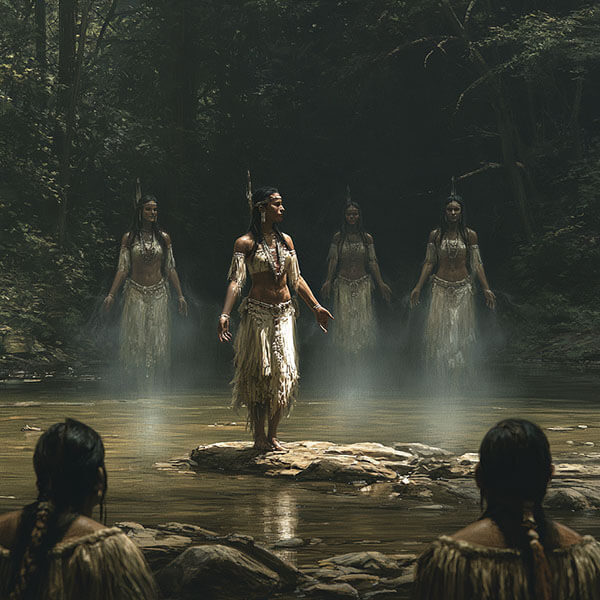
Nûñnë’hï are a race of supernatural, immortal beings, distinct from deities, spirits, and ghosts. They resemble the Cherokee people, despite remaining invisible most of the time, and are akin to faeries in European folklore. Dwelling in the Appalachian Mountains, where timber doesn’t grow, their Council Houses (ga-tu-yi, or townhouse) are invisible to humans unless they are invited inside.
Unlike the Yunwi Tsunsdi, spirits of little people who coexist with animals and spirits, the Nûñnë’hï appear identical to the Cherokee and have a closer association with humans—acting as protectors and allies.
Nûñnë’hï are enthusiasts of song and dance, much like the Cherokee people. When hunters wander throughout the Appalachian Mountains, they often hear singing, drumming, and music. Upon following the sounds, they either grow distant or appear to shift position, often behind the traveler. These are the signs that the Nûñnë’hï are nearby.
Due to their elusive nature, the Nûñnë’hï earned the nickname “The People Who Live Anywhere.” However, their immortality also merited them the names of “The People Who Live Forever” or “The Immortals” in some stories.
When Nûñnë’hï reveal themselves to humans, they are indistinguishable from the Cherokee people. Unlike other supernatural beings, the Nûñnë’hï are primarily benevolent, aiding the Cherokee in times of need.
Cherokee Folklore Involving the Nûñnë’hï
The Nûñnë’hï, also spelled Nunnehi, appear in many stories throughout Cherokee folklore. In the vast majority of these stories, the Nunnehi offer protection, guidance, and premonitions for the people. The Immortals offer the Cherokee to join them in the spirit world, live in immortality, and avoid tragedy for the destitute or those in need.
Yahula and the Nûñnë’hï
Yahula was a renowned trader who joined a hunting party deep in the Appalachian Mountains one day. The trader was known to ride a horse with a string of bells around its neck. The distinct sound allowed others in the hunting party to know exactly where Yahula was.
Upon completion of the hunt, the party began their return home. They quickly noticed the tinkling of the bells was absent from their retreat. Yahula was nowhere to be found. After searching and waiting for the man for several hours, they assumed the worst. He most likely perished in the mountains.
His family and friends mourned his death, assuming he had “gone to the West,” in the land of the spirits. However, one day, Yahula appeared at his home to the delight of his family. He told them how he was lost in the harsh environment when the Nunnehi offered him shelter. Taking up their offer, Yahula joined the Immortals.
Ecstatic at Yahula’s return, his family offered him the food they were preparing. Calmly, Yahula explained that he had already eaten the food of the Nunnehi and could no longer eat the food of his people. He took leave, stating he must return to the Nunnehi . Despite the pleas of his family, Yahula said he was better off living eternally with the Nunnehi than dying with his own people. This news caused his family and friends to weep. Upon stepping through the door, the man disappeared.
Yahula continued to make frequent visits to his home to see his friends, wife, and children. Each time he stepped out the door, the man vanished. Upon stepping through the threshold of the spirit realm, he vanished. His visits grew more frequent until one day he disappeared. The village assumed that Nunnehi did not like his frequent contact with his people.
Upon a hill above the village where Dahlonega now resides, sat a perfectly carved square stone. Villagers believe this was Yahula’s house. At night, they could hear his singing. However, one night, his best friend ventured into the area and began singing his song. Shortly after, the friend perished. The villagers concluded that they would never sing his song again.
Shortly after this, the singing of Yahula ceased. He was nowhere to be found. His friends and family noted that he most likely traveled across the mountains, heading westward.
The Dance at Nottely
Nottely was a small village in the Blue Ridge Mountains in Northern Georgia. Residing near the Nottely River, the village hosted a dance one evening. As the inhabitants danced, sang, and feasted, four beautiful women arrived to join the festivities. Assuming they were from a neighboring village or travelers, the residents welcomed their presence.
After the revelry wrapped up, the women took their leave and disembarked on a path leading to the river. Some of the men from the village followed, curious about their origins. Upon arriving at the river, the four beautiful women disappeared. The men realized they were Nunnehi, and returned home to tell the village what they witnessed.
Premonitions of the Nûñnë’hï
The Nûñnë’hï, altruistic in nature, are featured in several stories in which they warn the Cherokee people of imminent danger. The Immortals were protective and caring for their Cherokee allies. Both lived in practical harmony within the same lands. While the Cherokee respected the elusive Nûñnë’hï, the Immortals paid the same respects to the people.
The Cherokee Removal of 1838
One such incident occurred shortly before the 1838 Cherokee Removal, which led to the Trail of Tears. The Nûñnë’hï appeared at a Cherokee village seven days before the Removal commenced. They instructed the village to pack their belongings and prepare to join them, or face a threat unlike the Cherokee had experienced before.
After the seven days had elapsed, the Nûñnë’hï returned to the village and led the Cherokee who were willing to follow them to a large stone in the mountains. Unveiling this stone revealed an entrance into the mountain, leading to the most beautiful scenery the villagers had ever seen. While some Cherokee chose to stay back, others followed the Nûñnë’hï to their new home in their ancestral mountains. Unfortunately, the Cherokee that remained were eventually relocated to Oklahoma. Some Cherokee remain in the Appalachian mountains. Stories explain this as the ones who followed the Nûñnë’hï to safety before the Cherokee Removal of 1838.
Nûñnë’hï Protecting Their Cherokee Allies
Several other stories involve the Nûñnë’hï offering protection for the Cherokee. As allies, they fought alongside each other and used their clever wit to thwart danger.
The Battle of Nikwasi
Nikwasi, meaning Star Place, was a village in North Carolina near the modern city of Franklin. In one event, a powerful, undisclosed neighboring tribe invaded the village at Nikwasi. Ambushing the settlement at dawn, the Cherokee suffered extensive casualties. When all seemed lost, a stranger approached the Nikwasi chief. The stranger assured the chief that they would deal with the invaders, and he should focus on retreating with the survivors.
Heeding the warning, the chief gathered the settlers and retreated to the mountains. A mound opened within the center of the settlement, and a horde of Nûñnë’hï came forth. Since the Immortals possess invisibility, they slaughtered the invading warriors with ease. Those who surrendered were allowed to live but were told to carry the story back to their tribe as a warning against further incursions.
The Ploy at Franklin, North Carolina
As Union soldiers advanced against the Confederates during the Civil War, they adopted a slash-and-burn strategy. Razing villages on their way south, the Nûñnë’hï saw imminent danger for the city of Franklin, formerly Nikwasi. In a clever ploy, Union soldiers were tricked by the Nûñnë’hï into believing that Franklin was heavily guarded. Scouts for the Union returned to their commanders, advising them to bypass the city. However, the city was virtually undefended, as most of the able-bodied men were already fighting in the war.
While in history the Union did bypass the city of Franklin, it was due to the city’s geographic isolation. The rugged terrain, lack of a railway, and isolation made it a destination out of the way of the advancing army. Its location spared it from destruction.
Offerings of Assimilation by the Nûñnë’hï
While the Cherokee and the Nunnehi were distinct beings, their proximity and respect for one another led them to become cherished allies. On several occasions, the Nunnehi offered the Cherokee people the chance to join them and become immortal as well. While the premise is enticing, Immortals cannot return to the world of the living once joining the spirits.
Hiwassee River Invitation
A story describes the Nunnehi offering a group of Cherokee living near the Hiwassee River to join their community. They allowed them seven days, in usual fashion, to make preparations and decide to join the Immortals.
A handful of Cherokee agreed and joined the Nunnehi at the Hiwassee River. Those who remained could hear the voices of the kin in the river as they visited it. As the fishermen used ancient weirs to catch coral fish in the river, their kin who became Nunnehi would often catch their lines so the fishermen would not forget them.
Council House Removal
While myriad stories exist of the Nunnehi offering to let the Cherokee join them, most arose from threats of crisis or warfare. In one such incident, the Nunnehi provided the Cherokee with a seven-day grace period, stating they’d return to remove the Council House to protect the villagers from impending danger. They advised the villagers not to panic and to keep quiet during the Removal.
While most adhered to the orders, a thunderous sound rang out as the Nunnehi carried the Council House away from the village. Naturally, some of the inhabitants became frightened and cried out. This startled the Nunnehi, causing part of the house to break off. They successfully relocated the remnants of the Council House to Lone Peak, where a solid rock marks the spot of the Cherokee’s transition to Immortals.
The part of the house that broke off became a mound within the old settlement, now called the Setsi (Tsetsi) Mound. The location is still considered a sacred place today and is located in the city of Franklin, NC.
Frequently Asked Questions
What are the Nûñnë'hï in Cherokee mythology?
The Nûñnë'hï are a race of supernatural, invisible, immortal beings found in stories throughout Cherokee mythology. When they choose to appear to humans, they take on the form of ordinary Cherokee people. However, their dwellings are invisible and scattered throughout the Appalachian Mountains.
Where do the Nûñnë'hï live?
The Nûñnë'hï live in communities that mirror those of Cherokee settlements, despite being invisible to humans. Their communities are dispersed throughout the Appalachian Mountains, often near Cherokee villages or high in the mountains where timber doesn't grow.
Can people see the Nûñnë'hï?
The Nûñnë'hï are innately invisible to people. However, they can reveal themselves, taking the appearance of ordinary humans.
Are the Nûñnë'hï good or evil?
Nûñnë'hï are generally benevolent beings, often providing aid to the Cherokee by offering shelter, premonitions, or protection from imminent danger.
What magical abilities do the Nûñnë'hï have?
Nûñnë'hï are magical creatures with a range of magical abilities that aid the Cherokee people. Some of these include: invisibility, healing, illusions, longevity, and facilitating Cherokee transformation into immortality (becoming Nûñnë'hïs).
What other mythologies have hidden people?
Hidden people appear throughout a wide range of other mythologies. While the Nûñnë'hï are distinct from Cherokee culture, ancestry, and folklore, other hidden beings include:
- Huldufólk - Norse Mythology
- Aos Sí - Irish Folklore
- Tylwyth Teg - Welsh Folklore
- Sìth - Scottish Folklore
- Elves - Germanic Folklore
- Ulda - Sámi Folklore
- Menehune - Hawaiian Folklore
How do the Nûñnë'hï differ from the Yunwi Tsunsdi (Little People)?
The Yunwi Tsunsdi are another race of immortal supernatural beings similar to the Nûñnë'hï. Their differences lie particularly in their size. While Yunwi Tsunsdi are child-sized, Nûñnë'hï appear as full-grown humans.
How can you tell if the Nûñnë'hï are nearby?
Nûñnë'hï reveal their presence primarily through song and music. Hunters and travelers report hearing sounds of singing, drumming, and dancing deep in the mountains. Upon following the sounds, they prove elusive, changing locations and confusing the traveler.
What happens if you eat the food of the Nûñnë'hï?
Eating the food of the Nûñnë'hï grants immortality to a person and initiates their transition from the mortal to the spirit realm. Once a person eats this food, they are unable to consume the food of mortals again.
Why are the Nûñnë'hï compared to European fairies?
Many tales of European fairies include parallels to the Nûñnë'hï. Both beings are invisible, thought to live underground, possess magical abilities, and aid humans in their time of need. One major distinction lies in the behavior of these beings. Fairies tend to be mischievous in nature, while Nûñnë'hï act in a noble and dignified manner.
Sources
- Mooney, J. (1900). The Nûñnë'hï and Other Spirit Folk. In Myths of the Cherokee (19th Annual Report of the Bureau of American Ethnology, 1897–1898, Part I). Smithsonian Institution. https://sacred-texts.com/nam/cher/motc/motc078.htm
- Mooney, J. (1900). Yahula. In Myths of the Cherokee (19th Annual Report of the Bureau of American Ethnology, 1897–1898, Part I). Smithsonian Institution. https://sacred-texts.com/nam/cher/motc/motc086.htm
- Wikipedia contributors. (n.d.). Nûñnë'hï. Wikipedia, The Free Encyclopedia. https://en.wikipedia.org/wiki/N%C3%BB%C3%B1n%C3%AB%27h%C3%AF